
One of the first questions in an AGV project is also one of the easiest to answer incorrectly: how many vehicles does the factory actually need? Buying too few AGVs can create queues, missed production takt, and delayed material delivery. Buying too many increases equipment investment while leaving part of the fleet underused. The correct AGV fleet size is therefore not determined by floor area or transport distance alone. Wesar normally evaluates the customer’s production demand, transport routes, pickup and delivery points, route geometry, waiting time, charging requirements, equipment interfaces, and required production takt together before defining the required number of AGVs.
Why Is AGV Fleet Sizing More Complicated Than a Simple Formula?
A rough calculation can provide a starting point, but real factories contain delays that a basic distance-and-speed formula cannot fully represent.
Why Is Travel Time Only Part of the Cycle?
Suppose an AGV travels 80 meters from a warehouse to a production line. Dividing distance by vehicle speed may provide an estimated travel time, but it ignores much of the real operating cycle.
The vehicle may need to:
- wait for a pallet to become available,
- align with the pickup position,
- lift or receive the load,
- slow down at intersections,
- negotiate turns,
- wait for an automatic door or elevator,
- transfer the material at the destination,
- travel empty to its next task,
- or enter a charging cycle.
All of these events affect how many transport tasks one AGV can complete per hour.
Why Can Two Identical Routes Need Different Fleet Sizes?
Two factories can have the same route length yet require different numbers of vehicles.
One may have straight, open travel lanes with only two transfer points. The other may contain multiple turns, shared intersections, production equipment interfaces, and frequent traffic conflicts.
The second system has more non-travel time, so each AGV completes fewer cycles during the same shift.
That is why fleet sizing must start with the complete logistics process.
Which Factors Determine How Many AGVs a Factory Needs?
Wesar’s engineering calculation considers the customer’s actual material flow rather than selecting an arbitrary vehicle quantity.
How Does Production Takt Affect AGV Quantity?
Production takt is one of the most important inputs.
If a line requires a new pallet every five minutes, the AGV system must consistently support that rate. Average performance is not enough if the fleet regularly misses peak requirements.
The calculation therefore needs to consider required moves per hour, peak periods, shift pattern, and whether several production lines request materials at the same time.
The objective is not simply to keep the AGVs busy. The objective is to make sure material arrives according to production demand.
Why Does Route Length Matter?
Longer routes naturally increase cycle time, but the important figure is the entire loaded and unloaded route.
An AGV may travel loaded from point A to point B and then travel empty toward another pickup point. That empty movement still consumes fleet capacity.
A professional calculation therefore analyzes transport loops rather than just the loaded distance shown on a layout.
How Do Pickup and Delivery Points Affect the Calculation?
Every docking point introduces process time.
The AGV may need to stop accurately, detect the carrier, insert forks, lift the pallet, wait for equipment confirmation, or exchange signals with production machinery.
A system with ten pickup and delivery locations can therefore behave very differently from a simple two-point shuttle route.
The sequence in which these points generate tasks also affects vehicle allocation.
Why Do Turns, Intersections and Traffic Matter?
A route drawn on a CAD layout may look short while still being operationally slow.
How Do Turns Add Time?
AGVs generally reduce speed when turning or approaching constrained areas. A route containing many 90-degree turns may therefore take noticeably longer than a straight route of equal distance.
Vehicle size also matters. Heavy forklift AGVs may require larger turning spaces and different speed profiles from compact mobile robots.
Wesar’s team considers these route details when evaluating cycle time instead of assuming that the AGV travels at maximum rated speed for the entire journey.
What Happens When Multiple AGVs Share the Same Route?
As fleet size increases, vehicle interaction becomes more important.
AGVs may meet at intersections, narrow aisles, shared transfer points, charging areas, elevators, or automatic doors. Robot control software can coordinate these movements, but traffic management still consumes time.
Adding vehicles beyond a certain point does not necessarily increase throughput proportionally. In a congested layout, an oversized fleet may simply create more waiting.
How Do Loading, Unloading and Equipment Interfaces Change Fleet Size?
Material transfer can consume a significant share of the AGV cycle.
Why Must Docking Time Be Measured?
For a forklift AGV, a transport cycle includes more than driving. The vehicle must approach the pallet, position itself, insert the forks, lift the load, exit the pickup area, and later complete the reverse process at the destination.
If each transfer takes tens of seconds or several minutes, this time must be included in fleet sizing.
The same principle applies to conveyor transfer, production-machine interfaces, racks, elevators, automatic doors, and other equipment.
Why Does Waiting Time Matter?
Sometimes the AGV is ready but the process is not.
A machine may still be completing its previous cycle. A conveyor may be occupied. An elevator may be serving another floor. A worker may not yet have released the pickup station.
These delays reduce effective vehicle availability and should be considered when designing the system.
How Should Charging Be Included in AGV Quantity Calculations?
An AGV cannot transport material while it is unavailable for charging or maintenance.
Does Automatic Charging Mean Charging Time Can Be Ignored?
No.
Automatic charging makes fleet operation easier, but energy management still affects available transport capacity.
The engineering team needs to consider operating hours, battery capacity, charging time, charging strategy, task intensity, and whether charging can be performed during natural idle periods.
For highly utilized systems, the charging strategy can influence whether an additional vehicle is required.
Is There a Simple Formula for Estimating AGV Quantity?
A preliminary estimate can be useful during early planning.
What Does a Basic Estimate Look At?
At a simplified level, engineers compare the required number of transport cycles with the effective number of cycles one AGV can complete during the same period.
For example, if production requires 20 deliveries per hour and one AGV can reliably complete five full cycles per hour under real operating conditions, the theoretical requirement begins around four vehicles.
However, this is only a screening calculation.
The actual design must account for traffic delays, charging, task peaks, route imbalance, equipment waiting, maintenance allowance, and the fact that not every AGV will be perfectly utilized every minute.
For this reason, Wesar does not rely on a single fixed formula when finalizing fleet size.
Why Is Simulation Important Before Finalizing the Number of AGVs?
Simulation helps engineers see what static calculations can miss.
Can a Fleet Look Sufficient on Paper but Still Fail?
Yes.
A useful example from AMR warehouse planning involved a system initially planned with 15 carton-transfer robots. Simulation showed robot utilization reaching approximately 95%, indicating that the planned fleet was insufficient.
After additional simulation, the quantity was increased to 19 vehicles. The final configuration better matched workstation picking efficiency and required outbound takt.
This illustrates an important point: the correct AGV quantity is the quantity that satisfies the process, not the smallest number produced by a theoretical equation.
What Can Simulation Evaluate?
Depending on the project, engineers can evaluate route congestion, vehicle utilization, task completion, workstation demand, waiting time, task distribution, and bottlenecks before equipment is fully deployed.
It can also help answer another important question: whether the problem should be solved by adding another AGV or by improving the route and task logic.
Sometimes a layout change can create more capacity than simply purchasing another vehicle.
How Does Wesar Determine the Required AGV Fleet?
Wesar treats AGV fleet sizing as part of the overall system design.
What Information Does the Engineering Team Need?
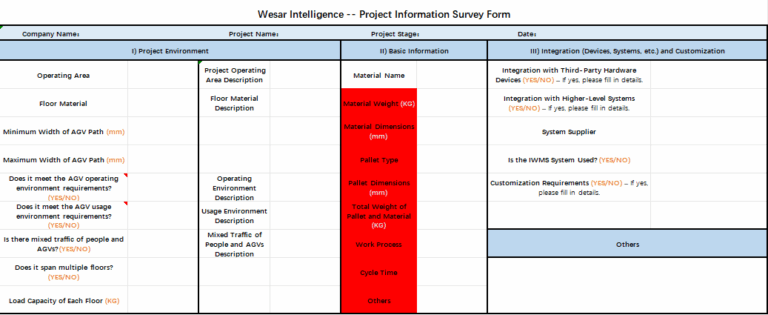
At the beginning of a project, the team collects information such as material type, load weight, carrier dimensions, pickup and delivery points, route layout, transport frequency, operating shifts, required takt, and existing equipment interfaces.
Route length alone is not enough. Engineers also evaluate turns, intersections, waiting points, docking time, empty travel, charging, and traffic between multiple vehicles.
Based on these conditions, Wesar can calculate and, where necessary, simulate the fleet required to meet the customer’s logistics demand.
Why Is This Better Than Choosing an AGV Quantity First?
Starting with an arbitrary vehicle quantity can force the rest of the system to adapt to the equipment.
Starting with the logistics requirement does the opposite: it allows vehicle quantity, model selection, routing, software, and charging strategy to be designed around the customer’s actual production process.
What Does Wesar’s AGV Project Service Process Include?
Vehicle calculation is only one part of an AGV project.
How Does the Project Move From Requirement to Operation?
Wesar’s integrated service scope covers planning, design, manufacturing, installation, and after-sales service.
In practice, an AGV project can follow a process such as:
- Requirement and material-flow analysis– confirm loads, carriers, routes, stations, throughput, takt, and system interfaces.
- Planning and fleet calculation– determine suitable AGV types, preliminary vehicle quantity, routes, charging strategy, and control requirements.
- Solution design and validation– refine the layout and, where required, use simulation to verify throughput, utilization, and bottlenecks.
- Equipment manufacture and system integration– prepare the vehicles, charging equipment, software, and required interfaces.
- Installation and commissioning– deploy the system on site, configure maps and tasks, integrate equipment, and test actual production workflows.
- After-sales support and optimization– maintain system performance and adjust operating strategies as material flow or production requirements change.
This full-process approach is important because AGV quantity is closely connected with every other system decision.
Why Can AGV Quantity Change as a Factory Expands?
Fleet sizing is not necessarily permanent.
Can More AGVs Be Added Later?
If production volume increases, transport points change, or new production lines are added, the required fleet can change.
A scalable fleet-control architecture allows factories to reassess traffic, routes, charging, and task volume before adding vehicles.
The important point is to recalculate the system rather than assume that a 20% increase in production automatically requires 20% more AGVs. Better scheduling or route optimization may absorb some additional demand, while a new bottleneck may require more capacity than the production increase alone suggests.
Conclusion
There is no universal answer to the question, “How many AGVs does my factory need?”
The correct number depends on production takt, required moves, route length, loaded and empty travel, pickup and delivery points, turns, intersections, transfer time, equipment waiting, fleet traffic, charging, and operational availability.
A simple calculation can provide an initial estimate, but final fleet sizing should be based on the real logistics process and verified where necessary through simulation.
Wesar’s professional team incorporates AGV quantity calculation into the complete project process, from planning and design through manufacturing, installation, commissioning, and after-sales support. The goal is not to sell the maximum number of vehicles. It is to configure enough AGVs to reliably meet the customer’s production rhythm without unnecessary fleet investment.
FAQs
1. Can I calculate AGV quantity using only route distance and vehicle speed?
No. These values provide only part of the cycle time. Pickup and drop-off time, turns, intersections, waiting, empty travel, charging, task peaks, and traffic between AGVs should also be considered.
2. Is it safer to simply buy one or two extra AGVs?
Extra capacity can provide redundancy, but blindly oversizing the fleet can increase cost and even create additional traffic congestion. The better approach is to calculate the required capacity and include an appropriate operational margin based on the actual project.
3. Can Wesar calculate the AGV quantity before the customer places an order?
Fleet sizing is part of Wesar’s project planning and solution-design process. The engineering team evaluates the customer’s material flow, routes, transfer points, production takt, and other operating conditions to determine an appropriate AGV configuration and quantity.






 English
  Russian
  Chinese