
An Automated Guided Vehicle (AGV) project starts long before the first vehicle arrives on site. The information collected during the initial stage affects vehicle selection, route planning, software integration, and project delivery. To prepare a workable solution, the AGV supplier needs clear data about the site, materials, pallets, workflow, system interfaces, and customization needs. Providing these details early can reduce repeated communication and prevent unsuitable equipment or late design changes.
What Basic Project and Site Information Should Be Provided?
The first step is to define the project and the environment in which the AGV will operate. Basic records and accurate site data give both sides a consistent reference for solution design.
Project Identity and Operating Area
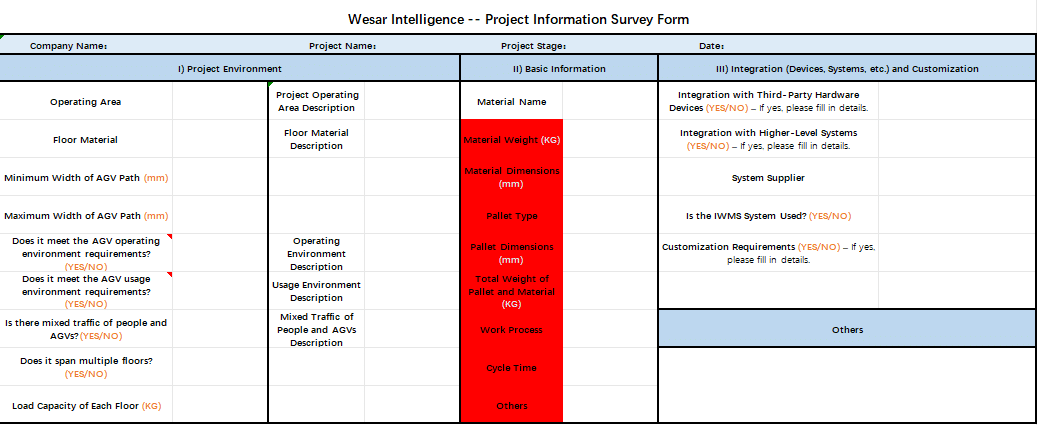
Clients should provide the company name, project name, project stage, and survey date. They should also describe the AGV operating area and floor material, and indicate whether the site meets the required AGV operating and usage conditions. Any special environmental conditions should be noted.
Path Width, Traffic, and Floor Conditions
The survey should include the minimum and maximum AGV path widths in millimeters. Clients should also confirm whether people and AGVs will share the same traffic areas.
If the project spans multiple floors, this should be stated together with the load capacity of each relevant floor. Whenever possible, site layout or CAD drawings should be provided so routes, workstations, transfer points, and space restrictions can be reviewed accurately.
What Material and Pallet Information Is Needed?
The AGV must be selected around the complete load unit it will transport. Material and pallet data therefore influence payload selection, lifting configuration, and pickup methods.
Material Weight and Dimensions
Clients should provide the material name, material weight in kilograms, material dimensions in millimeters, and the total weight of the pallet and material. The total loaded weight is important because the AGV carries the complete unit rather than the product alone.
If loads vary significantly, the relevant weight and size range should also be supplied.
Pallet Type and Dimensions
The survey should identify the pallet type and pallet dimensions. Different pallet structures may require different fork spacing, lifting arrangements, or transfer interfaces.
If several pallets, racks, carts, or carriers will be used, the main variations should be listed so the supplier can determine whether one vehicle configuration can handle them all.
What Process and Performance Information Should Be Shared?
Vehicle specifications alone do not show how the AGV will operate in the factory or warehouse. The supplier also needs the material-handling sequence and the expected operating rhythm.
Work Process and Cycle Time
Clients should describe the work process, including where materials are picked up, where they are delivered, and how the AGV fits into the current workflow. The survey also requests cycle time, which helps the solution team evaluate the required operating pace.
Additional conditions that do not fit the standard fields should be entered under “Others.” Special transfer steps or waiting points may affect route planning, docking, and task logic.
What Integration and Customization Details Should Be Confirmed?
AGVs often need to communicate with other equipment or business systems. Integration requirements should therefore be collected before detailed software and control design begins.
Third-Party Hardware and Higher-Level Systems
The client should confirm whether integration with third-party hardware devices is required and provide details when the answer is yes. The same applies to higher-level systems, including the relevant system supplier.
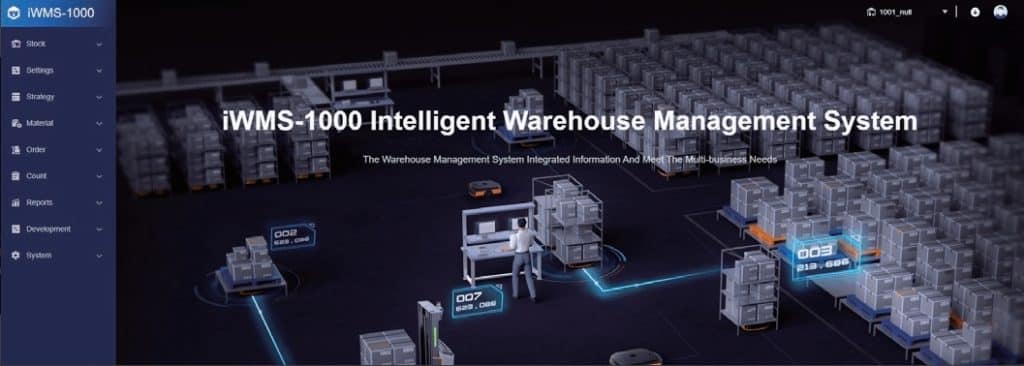
Clients should also indicate whether an iWMS system is already in use. These details help define the interface scope and clarify how AGV tasks will be managed.
Customization Requirements
Any customization requirement should be identified early and described clearly. It may affect hardware configuration, software functions, interfaces, or implementation planning. Early documentation reduces the risk of significant changes later.
Why Work with Wesar Intelligence Co., Ltd. on an AGV Project?
Once the survey information is complete, the next step is to convert it into a suitable robot configuration, route concept, software architecture, and implementation plan.
A Reliable AGV and Smart Warehouse Partner
Wesar Intelligence Co., Ltd. provides smart warehousing solutions combining logistics robots with system design and implementation services. Its portfolio includes Latent Mobile Robots (LMR), Forklift Mobile Robots (FMR), Carton Transfer Units (CTU), Conveyor Mobile Robots (CMR), Heavy-Duty Mobile Robots (HMR), and Mobile Collaborative Robots (MCR), together with software platforms such as iWMS and RCS. Wesar also provides integrated services covering consulting, software development, equipment, project execution, and after-sales support, allowing customers to work with one partner from initial survey through deployment.
What Should Be Confirmed Before Moving to AGV Implementation?
A complete project survey gives the solution team a stronger basis for technical planning and reduces uncertainty before implementation.
Final Project Readiness Check
In conclusion, clients should confirm the project details, operating area, floor material, path widths, traffic conditions, multi-floor requirements, floor load capacity, material and pallet data, total loaded weight, work process, cycle time, third-party hardware, higher-level system integration, iWMS usage, and customization needs. Providing layout or CAD drawings whenever possible further improves planning accuracy and helps define a clear project scope.
FAQs
1. Do We Need to Provide CAD Drawings at the Initial Stage?
CAD drawings are recommended when available because they help the supplier review routes, aisle widths, workstations, transfer points, and space restrictions. If CAD files are unavailable, a clear layout drawing with accurate dimensions can still support the initial review.
2. Why Is Total Pallet and Material Weight Required?
The AGV transports the complete load unit. Pallets, racks, or carriers add weight and can affect vehicle selection, so both material weight and total loaded weight should be provided.
3. Should Integration Information Be Provided Before the AGV Model Is Selected?
Yes. Integration requirements can affect system architecture, task logic, interfaces, and implementation scope. Details about third-party devices, higher-level systems, system suppliers, and existing iWMS usage should be collected during the initial survey.






 English
  Russian
  Chinese
  Japanese
  Italian
  Korean
  Spanish
  Arabic
  French
  German