
Warehouse automation becomes more difficult when incoming materials use different pallet structures, storage tasks arrive in peaks and equipment must serve more than one aisle. The solution needs more than a vehicle that can carry a load: it needs suitable handling hardware, a workable operating sequence and a layout that can be checked before installation.
In a recent product demonstration shared by Wesar, three capabilities were highlighted: a new forklift AGV intended for Chuan-pattern and Tian-pattern pallets, logistics simulation for advance workflow planning, and a dual-aisle STU concept that allows one device to operate between two aisles. These are related elements of an automation proposal, not evidence that every component is built into one vehicle. The video description does not provide a verified forklift model number, STU specification or project throughput result.
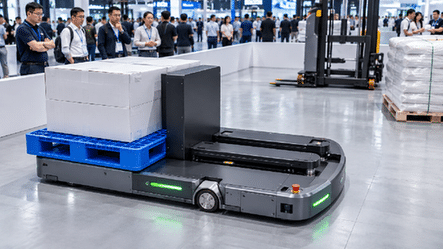
A pallet is not defined only by its outer length and width. The underside determines where forks can enter and what clearance the vehicle needs to lift the load. A Chuan-pattern pallet generally has a three-runner underside, while a Tian-pattern pallet has a grid-style support structure. Those descriptions are useful starting points, but actual fork openings and dimensions must be checked against the carrier supplied for the project.
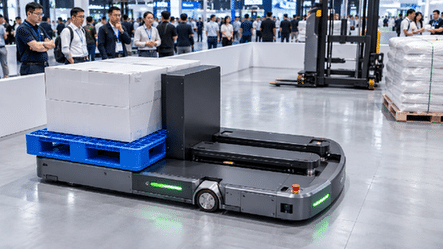
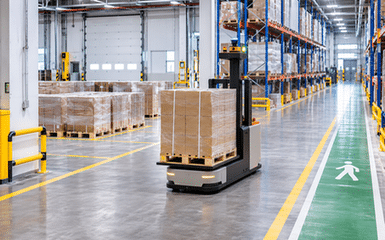
The customer demonstration introduces a new Wesar forklift AGV solution as compatible with both pallet patterns. That capability is commercially important for warehouses that receive materials from different suppliers or operate more than one pallet standard. It may reduce the need to reorganize every transport route around a single carrier design, provided the chosen configuration is validated with the real pallets.
For a trial, the warehouse should supply one representative pallet of each type, including typical load wrapping and any variations in condition. Confirm entry direction, fork clearance, support during travel and placement at the actual receiving station. A statement of dual-pallet compatibility should lead to an application test, not an assumption that every size or condition is accepted.
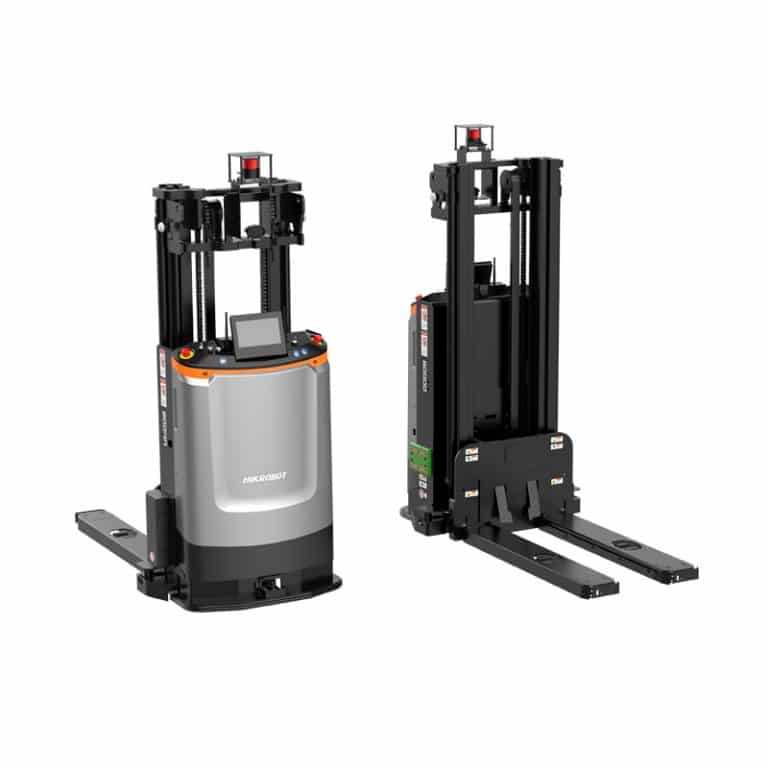
Wesar’s existing линейка мобильных роботов-погрузчиков (FMR) provides context for automated pallet transport. Its published model pages describe individual configurations; they should not be used to assign a model number or rated capacity to the new vehicle shown in the demonstration without the customer’s confirmation. For a separate account of fork geometry on older pallet configurations, see Wesar’s F3G-1500 pallet article; this does not identify the new vehicle.
Picture a mixed-pallet inbound operation. Pallets arrive at receiving, pass inspection and then move toward storage or a production buffer. The forklift AGV handles the approved pickup and transport task. The downstream storage equipment has a separate role in accepting and positioning materials. Software connects the sequence by defining when each move may begin and how completion is confirmed.
That is an illustrative workflow, not a claim about the installation in the shared video. It is useful because it exposes the required handoffs. Where is the load waiting? Which station becomes available first? Can an inbound pallet be released if both storage aisles are occupied? Each question affects the equipment and software configuration.
A proposal should specify where the forklift’s responsibility ends and the storage device’s begins. This prevents an apparent improvement in one part of the route from creating a queue at the next transfer point.
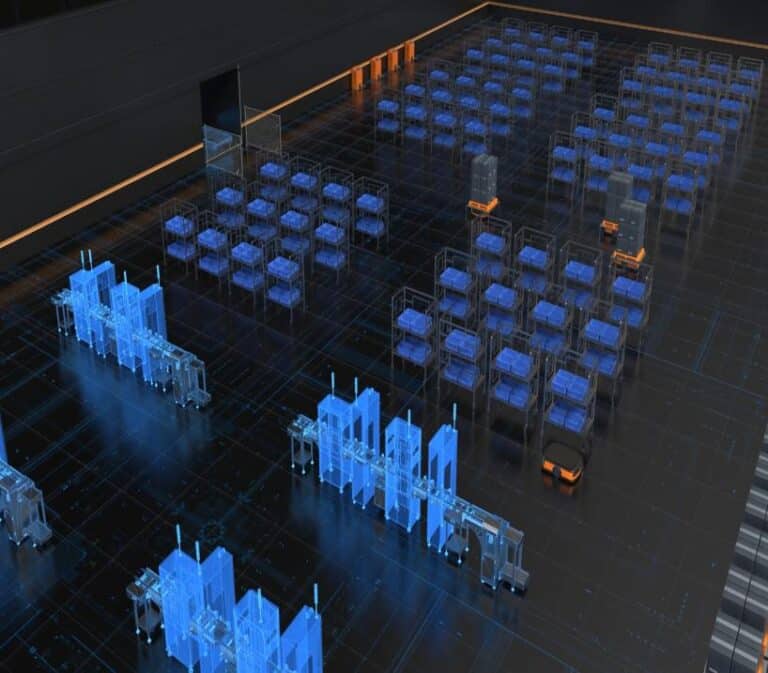
The customer highlights logistics simulation as a way to plan operating sequences before deployment. The purpose is not simply to produce a convincing animation. It is to test a proposed material flow against stated assumptions: the number of tasks, when they occur, the route geometry and the waiting space at each station.
Wesar’s iWMS-1000 warehouse management system describes business simulation using inputs such as site layout, route planning, task parameters, order structure and AMR operating parameters. That supports discussion of alternative layouts and workloads; the simulation result still depends on the accuracy of its inputs.
For a mixed-pallet project, simulate a normal shift and a receiving peak. Include both pallet patterns, station processing time and any shared transfer point. Then compare alternatives one change at a time, such as moving a pickup position or adjusting the task release order. The output can inform the next engineering decision, but it is not a substitute for validating the physical pickup and delivery conditions.
The shared Wesar demonstration describes a dual-aisle STU that can operate between two aisles. The potential value is operational flexibility: instead of evaluating the storage task in only one aisle, the planning team can consider how one device may serve requests arriving from either side.
However, dual-aisle access alone does not establish throughput, cycle time or the number of units needed. Those outcomes depend on travel distance, task order, load characteristics, access conditions and the rest of the storage system. No such measured values or detailed STU model data were supplied with the video summary.
A meaningful review therefore looks at two scenarios: routine requests distributed between the aisles and a peak in which both aisles need attention at the same time. Identify the handoff location, the queueing rule and who determines task priority. If the STU connects to an AGV transport route, both sides of the transfer must be represented in the proposed task sequence.
The forklift AGV, simulation environment and dual-aisle storage device address different questions. The AGV’s job is physical pallet transport; simulation is a design and evaluation tool; the STU performs its assigned storage movement. Their coordinated use requires a project-defined interface and task sequence.
For multi-robot handling, Wesar describes RCS-2000 as providing centralized assignment, scheduling and route planning. This describes a relevant control-system capability, but it does not by itself prove that the showcased STU has a specific ready-made interface. The actual integration, event messages and responsibility for each handoff must be confirmed for the proposed installation.
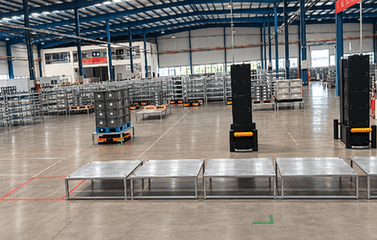
An acceptance test should trace one load all the way from its initial pickup to confirmed storage. Repeat with the other pallet pattern, a busy aisle and a destination that is temporarily unavailable. Observing the complete sequence is more informative than evaluating the forklift, the software model and the STU in isolation.
Buyers can make the next technical discussion much more productive with a short set of project materials:
Pallet information: actual Chuan-pattern and Tian-pattern samples, carrier drawings, fork entry, loaded weight and condition.
Operating layout: pickup and delivery points, aisle geometry, crossings, buffers and proposed STU location.
Workload: normal and peak movements by shift, time-critical tasks and what happens when a station is occupied.
Software scope: available WMS or production-system data, assumptions for simulation and the signals required between devices.
Acceptance scenarios: dual-pallet pickup, complete task handoff, both-aisle demand and the response to a blocked transfer point.
This information keeps the discussion tied to the actual warehouse. It also separates what the demonstration shows from what the proposed site still needs to verify.
The customer demonstration brings together three useful ideas for modern warehouse design: broader pallet compatibility from a new forklift AGV, earlier validation of the material flow through logistics simulation and more flexible storage-task allocation through a dual-aisle STU. The strongest proposal will show how those components fit a specific route and confirm each transfer using representative loads and operating conditions.
Does compatibility with Chuan- and Tian-pattern pallets mean every pallet is supported?
No. The stated capability covers the two pallet patterns presented in the customer demonstration. Actual dimensions, bottom structures, load conditions and entry directions still need model-specific confirmation.
Can logistics simulation guarantee the final warehouse throughput?
Simulation can compare scenarios under specified assumptions. Final performance also depends on equipment configuration, operating rules, physical constraints and site acceptance testing.
Can one dual-aisle STU always replace two independent machines?
Not necessarily. The demonstrated concept is operation between two aisles; the appropriate number of devices depends on the task mix, cycle-time requirements and integrated warehouse design.






 Russian
 English
 Chinese
 Japanese
 Italian
 Korean
 Spanish
 Arabic
 French
 German