
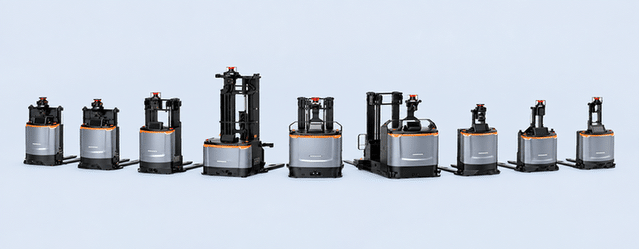
The phrase “EU pallet compatible” can make a forklift AGV search look settled before the buyer has described the pallet. Wesar’s F4-1000C page, for example, specifies an applicable pallet dimension of 1200 × 1000 mm. That is a precise statement about a listed model. At a plant using different carriers for incoming goods and line replenishment, the two fork interfaces need separate answers.
Wesar offers robots móviles de montacargas in carrying and stacking series. A model can match the carrier yet be wrong for the rack or line-side destination. The buyer therefore needs to describe the complete move, including the condition that ends the AGV’s task.
Pallet fit is a pickup-and-drop question
A pallet drawing is the beginning, but a photograph of the load at its normal pickup point may reveal more. Is the carrier presented lengthwise or crosswise? Are the fork openings clear after wrapping? Do cartons overhang? The model selected for a clean demonstration pallet may struggle with an offset carrier delivered from receiving. These are conditions for the proposed installation to test, not evidence that a particular Wesar model will fail.
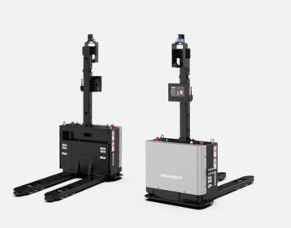
El F4-1000C data sheet lists a 1200 × 1000 mm applicable pallet dimension and identifies fork size and pallet recognition as customizable. For an EU pallet of another size, the quotation should name the exact carrier and fork configuration being assessed. If both sizes appear in the same flow, do not collapse them into “mixed pallets.” Give each a pickup orientation and destination. The interface may be acceptable for one and require a change for the other.
Weight is only one part of that interface. A load centre located farther from the mast changes the lifting condition even when the scale reading is unchanged. The highest, least stable load deserves a place in the trial plan. So does the damaged or slightly displaced pallet that still occurs in normal work. A successful run with an ideal empty carrier gives little assurance about these cases.
Where the stacking decision begins
A carrying AGV moves the load between floor-level handoffs. A stacking AGV must place it at height and withdraw without disturbing the adjacent storage position. The distinction sounds obvious, yet an RFQ may combine both under the single line “warehouse pallet transport.” Separate the moves before selecting a vehicle. The rack task may determine the model while the floor moves determine how many vehicles are needed.
Wesar publishes a 1,000 kg rated load, 2,031 mm fork lifting height and 2,062 mm minimum aisle width for the F4-1000C. The three figures invite three different checks. The load rating needs the actual load and load centre; lift height needs the proposed storage elevation; aisle width needs the approach path with a loaded pallet. At the bay entrance, the loaded forks sweep through a turn; the rack opening and pallet support position must accommodate the placement that follows.
A buyer should ask for a route and rack review based on measurements from the site. The practical test is a complete movement into the proposed location and back out again. If the pallet cannot be placed because the position is occupied, the team should already know whether the AGV waits, takes another task or calls for help. That recovery choice affects traffic just as much as a successful lift.
Production-line replenishment has its own endpoint
The forklift AGV might deliver a full pallet to a supermarket while operators prepare smaller kits for the line. In that arrangement, arrival at the supermarket is the AGV’s endpoint; it should not be described as automated delivery to each workstation. Another plant may have a line-side buffer designed to receive a pallet directly. The same vehicle family could be considered for both, but the release signal and unloading position differ.
A production manager can help define the requirement more clearly than a robot speed figure can. The busiest hour, the changeover deadline and the crossing queue establish the useful cycle time. Measure from a released pallet call to an accepted delivery; then add the return and charging time before estimating fleet capacity.
A full buffer turns a delivery into a traffic problem. The plant must designate a holding position or another response, then decide whether the transport task remains open. Without that rule, an apparently simple line-side drop can occupy the route needed by the next vehicle.
What the control-system discussion should cover
Wesar’s RCS-2000 page describes task assignment, AMR scheduling, route planning, equipment interaction and exception monitoring. In a proposal, ask which of these functions the RCS will perform for the actual route and which will remain with the site’s WMS, MES or equipment controller. A task should have a named origin, pickup confirmation and delivery confirmation.
For a door or lift, put the access signal and the safe waiting point on the route plan. At a manual-forklift crossing, define when the AGV yields. The exception screen should tell an operator whether the missing item is the pallet, a free destination or equipment permission; otherwise every stoppage becomes a search through several systems. These details are the substance of the integration work.
Ask for one defined movement first
To get comparable quotations, send a drawing of each loaded carrier, rack elevations, pickup and drop heights, the measured route, peak moves by hour and the equipment interfaces. Mark anything still estimated. Request separate responses for the floor-level delivery and the rack placement, with a proposed configuration and an acceptance test for each.
The two responses may specify different vehicles. They may also expose a fork change for the site’s EU pallet or a rack approach that needs more space. Resolve those points before commissioning becomes the first full-scale experiment.
Record the acceptance sample before the supplier visit: pallet dimensions, load centre, maximum lifted height, aisle geometry and the signal that closes the delivery. A short repeatable route lets the warehouse, production and automation teams review the same evidence. It also makes a later change to the pallet, rack or line-side buffer visible instead of hiding it inside a general “AGV performance” statement.
The site team can keep the sample simple. Photograph one loaded EU pallet at receiving, mark the approach direction on the floor and measure the clearance beside the rack. Note how long an operator waits when the destination is occupied. Those observations give the supplier a useful starting point for navigation, fork detection and task recovery. They also give the buyer a shared record to revisit after a shift change or a layout adjustment.
Conclusión
A forklift AGV is selected for a particular loaded pallet and a particular handoff. The published F4-1000C parameters help screen a stacking option, while the actual carrier, rack approach and production-line release process determine the installation.
Preguntas frecuentes
Does the F4-1000C product page confirm every EU pallet format?
No. It lists 1200 × 1000 mm as the applicable pallet dimension. Another format needs a carrier and fork-interface review for the proposed configuration.






 Spanish
 English
 Russian
 Chinese
 Japanese
 Italian
 Korean
 Arabic
 French
 German