
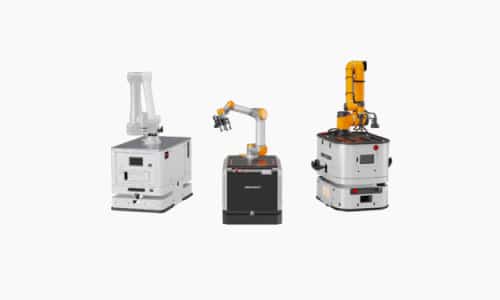
An AGV carries material between locations, while a robotic arm performs precise work at a station. Combine them and the result is a mobile manipulator: a composite robot that can travel, position itself, perceive an object, and complete a handling task. This AGV and robotic arm integration extends automation beyond fixed cells. It can support machine tending, line-side replenishment, sample transfer, inspection support, and pick-and-place workflows in flexible manufacturing. The same concept can also use an AMR base when dynamic navigation is appropriate, so AGV, AMR, robotic arm, and mobile collaborative robot should be evaluated as parts of one operating system rather than isolated machines.
What Is an AGV Robotic Arm Composite Robot
A composite robot combines mobile movement with manipulation. The mobile base provides the transport function, while the arm, gripper, vision system, controller, and software complete the work at each destination. Wesar groups this type of solution under its Mobile Collaborative Robot MCR portfolio. The exact configuration should be selected for the payload, reach, precision, end-effector, station interface, and route.
The mobile base provides the feet
The AGV or AMR base determines payload reserve, footprint, navigation method, turning behavior, stopping accuracy, runtime, charging, and traffic interaction. It must carry the arm, controller, vision hardware, tooling, and workpiece without compromising stability. A compact base may improve access, while a larger platform may offer more payload and a wider support area.
The robotic arm provides the hands
The arm determines reach, degrees of freedom, repeatability, speed, and usable working envelope. The end-effector converts that motion into a task: gripping a tray, opening a machine door, loading a component, handling a sample, or presenting a part for inspection. Tool and part sensing should confirm a secure grip before the base moves.
Vision and control provide the eyes and brain
Vision-guided robotics can locate parts, identify orientation, and compensate for variation at a station. The controller coordinates localization, docking, arm motion, equipment signals, and recovery logic. A safe sequence must prevent the vehicle from moving while the arm is in an unstable pose and prevent arm motion until docking and workspace conditions are confirmed.
Where Does a Mobile Manipulator Create Value
A mobile manipulator is most attractive when several stations need the same automated skill but do not justify a dedicated arm at every point. It can also help when product mix, routing, or production priorities change. The business case should compare the shared robot’s travel and setup time with the utilization and flexibility gained.
Machine tending and CNC loading
For machine tending, the composite robot can bring blanks or trays to a machine, dock, exchange parts, and move completed items to the next step. This may reduce repetitive manual loading across CNC machines, test equipment, or inspection stations. Reliable deployment depends on door signals, chuck or fixture status, part presence checks, reach analysis, and a defined response to jams or rejected parts.
Line side replenishment and work in process transfer
An AGV with robotic arm can transport bins, trays, or components and place them at a line-side point rather than stopping at a general drop zone. In electronics, automotive parts, and machinery production, this can connect warehouse logistics with assembly operations. The design should clarify whether people will share the station and whether the arm is intended for collaborative operation.
Inspection sample and tool movement
A mobile collaborative robot can move gauges, samples, tools, or small workpieces between controlled locations. It may present a part to a camera or measurement device, then route the result according to process logic. This supports flexible automation, but the project still needs traceability, calibration, access control, and stable presentation geometry.
How Should the AGV and Robotic Arm Be Engineered Together
Successful integration starts with one combined risk and performance model. Payload, reach, speed, center of gravity, stopping behavior, docking tolerance, and station cycle time must be calculated together. Treating the arm and mobile base as separate purchases can leave gaps in stability, power, communication, or safety responsibility.
Check stability throughout the arm workspace
The critical condition may occur when the arm is fully extended with a workpiece, not when it is folded for travel. Engineers should analyze static and dynamic loads for every required pose. Mechanical stops, software limits, support mechanisms, or restricted arm envelopes may be needed. The vehicle should travel only in approved arm and tooling positions.
Design docking around the required task accuracy
Navigation accuracy and manipulation accuracy are related but not identical. If a process needs tight part placement, the system may use station landmarks, machine vision, mechanical alignment, or a calibration routine after arrival. The goal is repeatable task completion, not simply accurate vehicle parking.
Coordinate safety across motion modes
Risk assessment should cover travel, docking, arm operation, tool action, human entry, fault recovery, and maintenance. Safety scanners, emergency stops, speed limits, protective zones, interlocks, and status indicators must act as one system. Collaborative arms do not automatically make every mobile manipulation task collaborative; tooling, workpieces, speeds, and the environment still matter.
How Do Software and Factory Systems Coordinate the Workflow
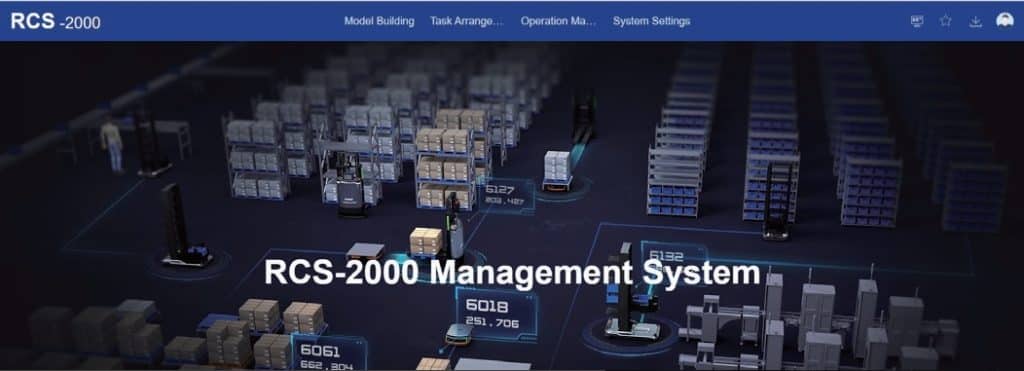
The workflow may begin in MES, WMS, ERP, or a production cell. An نظام التحكم الروبوتي RCS-2000 can assign the AGV or AMR, manage traffic, and send it to the destination. At the station, the robot exchanges status with the machine and launches the arm sequence. Wesar’s منصة البرمجيات includes robot, warehouse, and material-control functions that can be evaluated when designing this information flow.
Define a state machine and exception path
Each step should have a clear command, confirmation, timeout, and recovery action. Typical states include task accepted, route clear, station ready, docked, arm enabled, part detected, operation complete, and departure authorized. Exceptions such as missing parts, failed grasps, blocked aisles, machine alarms, or low battery need ownership and a safe fallback.
Why Consider Wesar for Composite Robot Integration
شركة ويسار للاستخبارات المحدودة provides intelligent factory solutions spanning AGV robots, AMRs, warehouse systems, software, equipment manufacturing, project execution, and support. That system-level scope is relevant to composite robotics because the mobile base, robotic arm, software, station equipment, and production process must work together. Buyers should begin with the target task, part and tool data, station drawings, route conditions, throughput, and system interface list.
خاتمة
AGV and robotic arm integration turns transport into flexible mobile manipulation. The strongest applications are not defined by novelty; they are tasks where one mobile robot can repeatedly move, dock, identify, grasp, load, unload, or present parts across multiple locations. Whether the base is described as an AGV or AMR, success depends on stability, task accuracy, safety, power, end-effector design, and software coordination. A carefully engineered mobile manipulator can connect warehouse robotics with production automation while adapting to changing factory workflows.
الأسئلة الشائعة
What is the difference between an AGV with a robotic arm and a fixed robot cell
A fixed cell performs tasks in one location. An AGV with robotic arm can serve multiple stations, but it must spend time traveling and docking. The right choice depends on utilization, cycle time, route availability, task repeatability, safety, and how often the production layout changes.
Can an AMR robotic arm perform machine tending
Yes, when payload, reach, docking, machine communication, part presentation, guarding, and recovery logic are engineered for the process. A feasibility study should verify the complete sequence rather than judging only the arm’s nominal reach or payload.
What data is needed to quote a mobile manipulator project
Provide part weights and drawings, pickup and placement tolerances, required arm reach, tool concept, station layout, machine signals, route dimensions, floor conditions, cycle targets, shift pattern, charging plan, human interaction, and MES, WMS, ERP, or equipment interfaces.





 Arabic
  English
  Russian
  Chinese
  Japanese
  Italian
  Korean
  Spanish
  French
  German