

Labor rates keep climbing, shift coverage gets harder to maintain, and plants need material flow that runs without constant human oversight—conditions that make forklift AGVs a serious consideration for handling pallet movement, high-level stacking, and tight line integration. Forklift AGV stacking height performance, horizontal transport consistency, production line docking precision, and multi-robot fleet coordination rank among the features most closely examined when teams assess upgrades for smarter warehouses and Industry 4.0 material handling.

Patterns drawn from automotive component lines, new energy battery assembly, electronics secondary packaging, and general manufacturing storage inform the discussion below. Coverage includes how these systems behave under actual duty cycles, contrasts with conventional manual or semi-automated equipment, persistent field limitations paired with workable countermeasures, examples from recent installations, and phased implementation sequences that limit exposure while advancing toward comprehensive autonomous logistics.
Core Functions of Forklift AGV Systems
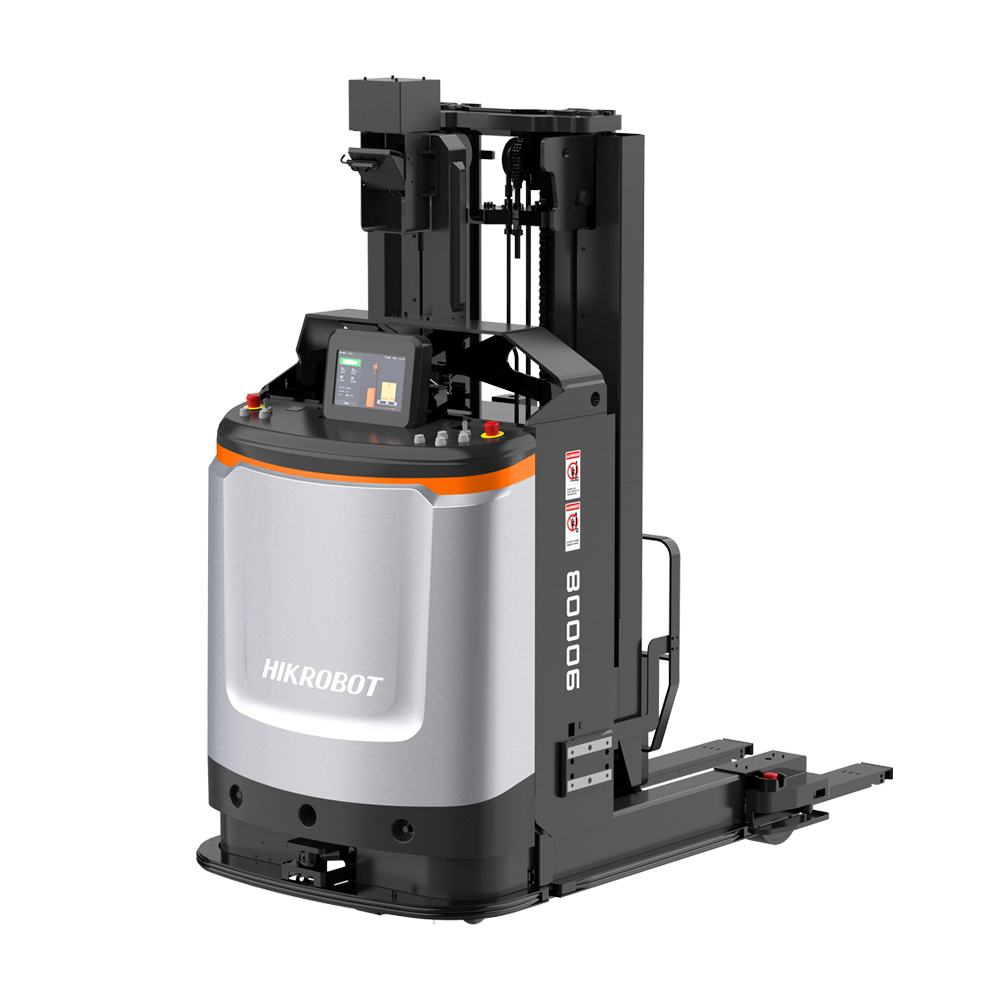
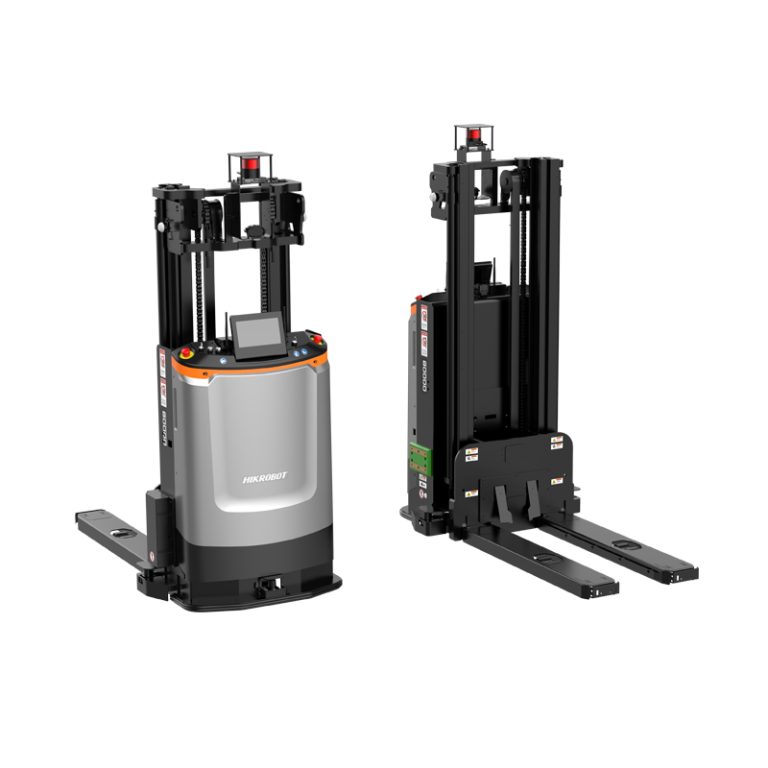
The basic architecture mounts forks or a specialized lifting carriage on an autonomous chassis. Navigation comes from laser SLAM, visual landmarks, or combined approaches. Vehicles retrieve pallets at floor level or low racking, move them horizontally through aisles and zones, raise loads for stacking, and position accurately at production interfaces or transfer points.
Stacking height defines much of the capability discussion. Standard configurations deliver stable lifts ranging from 1 to 5 meters, with certain narrow-aisle designs pushing higher. Payload rating typically holds full capacity up to 3–4 meters before tapering to maintain stability margins. Real-world repeatability at elevation depends on servo-driven control and anti-oscillation routines that dampen fork movement during reach.
Horizontal transport occupies the majority of operating time. Loaded speeds fall between 1 and 1.5 meters per second, with slightly higher values when empty. Payloads commonly sit in the 1–3 ton range across models. Route optimization software selects paths that minimize travel distance while obstacle sensors—LiDAR or camera arrays—preserve clearance in areas shared with personnel or other equipment.
Production line docking places stringent accuracy requirements. Common interfaces involve roller conveyors, lift tables, or vision-assisted alignment. Positioning accuracy reaches ±10–20 mm in baseline installations, narrowing to ±5 mm when vision guidance or hybrid laser methods come into play. Sequence timing aligns vehicle arrival with line pace, frequently depending on API links to manufacturing execution systems for synchronized transfers.
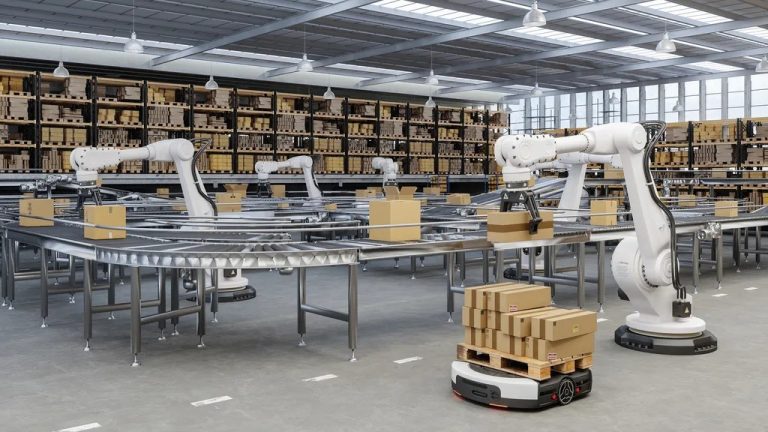
Multi-robot fleet coordination binds the individual functions into a cohesive operation. Forklift AGVs share the floor with latent models for pallet jacking, conveyor-integrated units for direct equipment feeding, or heavy-duty types for oversized handling; central scheduling assigns priorities, anticipates interference, and distributes battery drain evenly.
Performance Comparison: Forklift AGV vs. Traditional Manual Forklifts
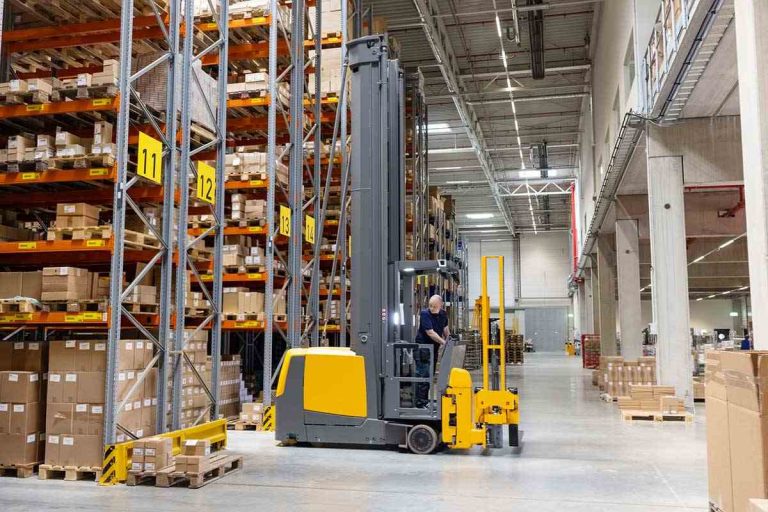
Manual forklifts depend on operator experience for uniform stacking height and safe horizontal transport. Extended shifts introduce fatigue, visibility limitations, and inconsistent decision-making, particularly at greater elevations or in congested zones.
Forklift AGVs provide repeatable execution. Stacking at 4–5 meters holds sub-centimeter precision through closed-loop control, whereas manual performance varies with individual skill and attention level. Horizontal transport continues without interruption, yielding higher utilization rates in continuous operations.
Initial capital outlay positions forklift AGVs above manual units—generally $50,000–$150,000 per vehicle including software, infrastructure, and safety provisions—against $20,000–$60,000 for a comparable electric forklift. Lifetime costs, however, tilt in favor of autonomy through diminished labor requirements, fewer collision-related repairs, and reduced product damage.
Space efficiency rises noticeably. Tighter aisle widths become practical when vehicles track exact paths, permitting denser racking without compromising accessibility.
Workload suitability diverges. Repetitive, high-volume pallet cycles in fixed zones favor forklift AGVs for uniformity. Dynamic environments or heavy human-robot interaction often retain manual elements during transition periods.
Production Line Docking: Accuracy, Methods, and Retrofit Considerations
Docking directly at production lines delivers some of the clearest operational returns. Roller conveyor transfers demand the forklift AGV to approach, align forks, and release pallets without disrupting upstream or downstream flow.
Typical approaches incorporate laser reflectors or QR markers for final positioning. Vision modules identify pallet skew and adjust approach vectors on the fly. Automotive body-in-white lines, for example, rely on these vehicles to supply subassemblies at precise takt intervals.
Retrofit scope varies widely. Vision-driven docking frequently requires only supplemental markers and improved ambient lighting. Mechanical adaptations—lift tables, automatic doors, or conveyor extensions—can involve moderate structural work, though many facilities introduce them incrementally.
Recurring difficulties include arrival timing offsets relative to line speed or intermittent communication between vehicle controller and plant systems. Platforms that integrate robot scheduling with line signals reduce these interruptions.
A deployment checklist covers conveyor elevation compatibility, speed matching tolerances, protocol verification (commonly Modbus TCP or OPC UA), pallet recognition reliability across lighting conditions, and stress testing under maximum throughput to expose latent constraints.
Multi-Robot Fleet Collaboration: Real-World Coordination Challenges and Solutions
Isolated forklift AGVs manage standalone tasks adequately. Greatest benefit surfaces in mixed fleets where forklift models handle elevated storage and retrieval while latent units manage ground-level pallet movement and conveyor types provide seamless line-side delivery.
Coordination depends on central robot control systems that prioritize assignments, forecast path overlaps, and adjust routes in real time. Edge-based prediction cuts idle periods by 20–35% in multi-vehicle areas during shift transitions or demand spikes.
Battery endurance becomes a limiting factor in diverse fleets. Charging opportunities or swap stations prevent disproportionate depletion, and workload balancing extends overall fleet runtime.
Path interference constitutes the most frequent operational interruption. Rigid routing produces deadlocks; dynamic forecasting that simulates traffic and reassigns priorities materially lowers wait times.
Electronics assembly facilities often pair forklift AGVs for rack access with conveyor units for component delivery. Automotive plants combine forklift models for heavy castings with latent robots for empty pallet circulation, forming efficient closed loops.
Long-term viability hinges on software extensibility—architectures with open APIs support gradual fleet growth without wholesale replacement.
Application Examples and ROI Insights from Recent Deployments
New energy battery lines deploy forklift AGVs for module stacking at 4–5 meters alongside conveyor docking. Installations demonstrate 25–35% reductions in direct material handling labor, with pallet stability adequate for automated securing and outbound movement.
Automotive component storage applies these vehicles for cross-dock transfers and high-bay placement. Advantages include lower traffic density in busy aisles and enhanced part traceability via onboard identification.
General manufacturing operations emphasize horizontal transport with periodic stacking. Payback intervals shorten to 18–36 months when replacing double-shift manual teams, accounting for labor savings, damage avoidance, and availability increases.
ROI assessments balance upfront expenditure against recurring items—battery service life, sensor cleaning, software maintenance. Projections covering 5–7 years, incorporating regional spares availability and remote support, yield credible forecasts.
Early setbacks frequently trace to insufficient fleet scheduling foresight—projects lacking predictive conflict resolution encountered congestion and prolonged commissioning.
Practical Rollout Paths for Mid-Sized Facilities in 2026
Committing to a complete forklift AGV fleet from the outset exposes plants to elevated risk while autonomous logistics capabilities mature. Sequential deployment corresponds more closely with budget discipline and operational familiarity.
Begin with transport fundamentals. Latent mobile robots establish pallet lifting and basic circulation, conveyor mobile robots connect line-side positions, heavy-duty models accommodate larger items. These initial phases confirm navigation reliability, charging discipline, and warehouse system integration while generating early efficiency gains.
Transport infrastructure proven, forklift AGV addition proceeds selectively—starting in high-frequency stacking locations or dedicated docking zones. Pre-existing fleet elements decrease incremental hardware investment and accelerate commissioning.
Evaluation criteria emphasize payload alignment with documented loads, lift height compatibility with racking, navigation resilience to floor variations, safety compliance in shared spaces, and software design that accommodates future expansion.
About Wesar Intelligence Co., Ltd.
Wesar Intelligence Co., Ltd., headquartered in Suzhou, Jiangsu, China, maintains a 5,000-square-meter manufacturing facility focused on intelligent logistics and smart warehousing equipment. The organization supplies end-to-end services encompassing application consulting, software platform engineering, hardware production, field deployment, and continued technical assistance. A workforce exceeding 100 members, including engineering and production specialists with nearly two decades of sector experience, supports precision manufacturing industries such as electronics, automotive components, and new energy.
Core product lines consist of autonomous mobile robots: latent mobile robots for pallet jacking and lifting, forklift mobile robots for stacking and transport duties, conveyor mobile robots for production equipment interfacing, heavy-duty mobile robots for substantial loads, carton transfer units, and mobile collaborative robots. Associated software platforms facilitate intelligent warehouse management, robot fleet control, and material coordination within Industry 4.0 frameworks. Priority remains on customized, market-aligned solutions that improve throughput, decrease handling discrepancies, and reduce sustained operational expense in intricate production and logistics environments.
Conclusion
Forklift AGV configurations advance dependable, adaptable material movement through solid stacking height execution, steady horizontal transport, accurate production line docking, and robust multi-robot fleet collaboration. These capabilities correspond closely with smart factory requirements for uninterrupted flow and minimized manual involvement, although durable outcomes demand realistic appraisal of precision boundaries, coordination demands, and incremental rollout. Plants realize the most consistent progress by solidifying transport foundations initially, then incorporating forklift functions where measured economics support the expansion. Continued development in sensing, control, and scheduling through 2026 and onward positions staged adoption as the most reliable approach to long-term operational improvement.
FAQs
How high can forklift AGV stack pallets in typical warehouse applications?
Common forklift AGV configurations provide stable stacking between 1 and 5 meters, with payload capacity decreasing at upper levels to preserve stability. Automotive and electronics deployments frequently target 3–4 meters for reliable day-to-day performance without extensive sway mitigation.
What accuracy is realistic for forklift AGV production line docking?
Baseline installations deliver ±10–20 mm positioning, improving to ±5 mm with vision or hybrid laser guidance. Line speed synchronization and MES communication consistency often influence overall reliability more than isolated positioning tolerance.
How do forklift AGVs coordinate with other AGV types in a multi-robot fleet?
Central control platforms allocate tasks, anticipate path interference, and distribute workloads across forklift, latent, and conveyor models. Predictive scheduling reduces congestion by 20–35% in mixed fleets during high-demand periods.
Is it possible to add forklift AGV stacking to an existing AGV fleet later?
In many cases yes—modular chassis designs accommodate payload increases and lift mechanism additions. Commencing with transport-oriented units safeguards initial returns and establishes a logical progression to stacking and docking functionality.
What payback period should factories expect from forklift AGV deployment?
Installations replacing multi-shift manual operations commonly achieve returns within 18–36 months, primarily through labor reduction, lower damage rates, and improved equipment availability. Realistic payback depends on confirming cycle performance and integration complexity during pilot evaluation.






 English
  Russian
  Chinese