
Procurement specialists and plant engineers in manufacturing and warehousing frequently turn to latent AGV systems when seeking low-profile, autonomous transport that slips under loads and integrates without tearing up existing setups. These vehicles—often called lurking AGVs or jacking AGVs—handle the heavy lifting beneath carts, racks, or pallets, then move them precisely to the next station. Discussions around latent AGV variants, docking sequences, and signal handshakes with roller conveyors, production machines, elevators, and automatic doors come up regularly during equipment evaluations.
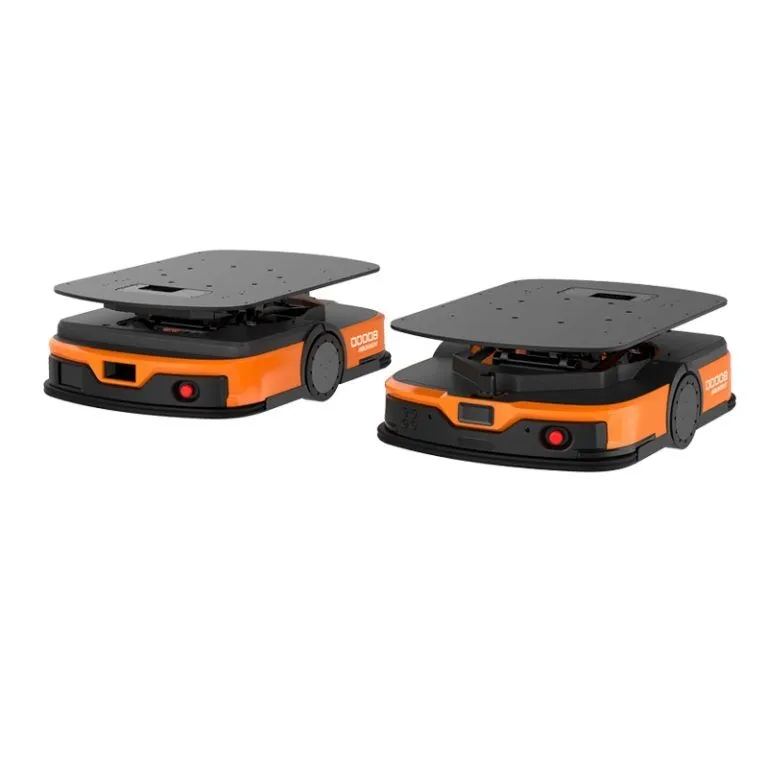
The core architecture stays consistent across types: compact frames, laser SLAM navigation for map-building without fixed infrastructure, and lifting mechanisms that raise loads just enough for clearance. Traditional lurking models serve as the foundation. Roller conveyor versions and heavy-duty units branch off from that base to address direct transfers or much larger payloads. Integration performance—especially reliable I/O exchanges and timing—determines whether the system runs smoothly or creates delays at transfer points.
The sections below detail each variant, their mechanical behavior in the field, docking procedures, and practical factors observed in automotive, electronics, and new energy facilities. Typical figures from deployments show payloads ranging 500 kg to over 10 tons, positioning accuracies of ±5–10 mm, and transfer cycles that fit high-frequency production rhythms.
What Is a Traditional Latent (Lurking) AGV?
Traditional latent AGVs navigate underneath a trolley, shelf, or pallet carrier and extend a jacking mechanism—hydraulic in some cases, electric in others—to lift the load off the ground for transport. The vehicle stays mostly below floor level during travel, which lets it pass through tight aisles or under low obstacles typical in dense production zones.
Laser SLAM handles navigation, scanning natural features to create and refine maps on the fly. That capability proves valuable in plants where layouts shift with new product runs or seasonal adjustments. Lift heights generally sit between 50 and 100 mm, enough to clear caster wheels while keeping the load stable.
Standard payloads fall in the 500 kg to 2-ton range, governed by wheel size, drive power, and battery sizing. Walking accuracy usually reaches ±10 mm, with final docking positions tightening to ±5 mm. Batteries deliver 8–10 hour runtimes in average-duty cycles, recharging automatically at opportunity stations during breaks.
The approach keeps interference low. Once the load is raised, central fleet software plots collision-free paths using 360-degree obstacle detection and predictive routing. In electronics assembly lines or precision sheet metal operations, these units move work-in-progress carts station to station, cutting forklift movements and the safety incidents that go with them.
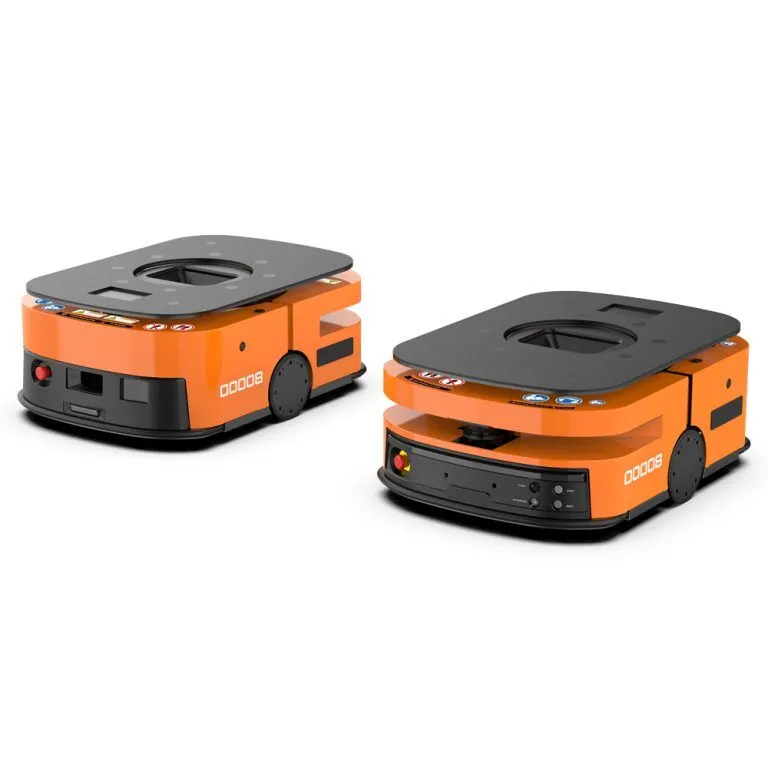
Roller Conveyor AGV Variant
Roller conveyor AGVs take the latent base and add powered rollers to the upper deck, allowing direct load exchange with fixed roller lines instead of relying on separate lift tables or manual intervention.
The vehicle moves into position under the conveyor end, raises to match elevation, and triggers the rollers once alignment is confirmed. Signal exchange drives the sequence: the AGV indicates readiness, the line acknowledges position, rollers spin until sensors register full transfer, then the vehicle drops and clears the area. Lateral and height alignment typically stays within ±5 mm and ±2 mm to avoid jams.
Payload capacity mirrors the base models, commonly 500–1500 kg, though the roller assembly adds a small amount of weight. In automotive component feeding or warehousing high-turnover zones, these variants move parts straight from storage buffers to assembly belts. Transfer times shorten noticeably; some sites measure 20–30% faster flow at conveyor junctions compared with manual methods.
Beyond simple I/O handshakes, many units handle Ethernet/IP or Modbus for detailed status sharing—load presence, fault alerts, queue status. In plants already equipped with roller conveyors, this variant reduces retrofit expense while automating buffering and sortation steps.
Heavy-Duty Latent AGV
Heavy-duty latent AGVs scale the lurking principle to handle industrial loads from 2 tons up to 10 tons and beyond. Reinforced frames, larger drive wheels, and multi-axle layouts provide the necessary stability, while stronger jacking systems—often synchronized hydraulics or heavy-duty electric actuators—manage the lift.
Navigation continues with laser SLAM, sometimes supplemented by inertial units in dusty or highly reflective settings. Lift heights extend to around 150 mm to clear uneven floors or rail-guided fixtures.
These models see heavy use in automotive stamping plants, new energy battery lines, and large sheet metal operations where molds, dies, or oversized fixtures need shifting between presses and storage bays. Higher payloads call for larger lithium-ion battery packs and more frequent opportunity charging during production pauses.
Docking follows the same signal logic as lighter models but adds extra safety layers. The AGV waits for load stability confirmation before lowering, and the receiving side verifies clearance. Positioning holds at ±10 mm or tighter even under maximum load, thanks to improved sensor integration.
Key Integration Features: Docking with Roller Lines, Production Machines, Elevators, and Automatic Doors
Deployment success depends on clean, dependable interfaces. Latent AGVs rely on digital I/O for basic handshakes, wireless links (Wi-Fi or 5G for reduced latency), and occasionally API-level communication to sync with adjacent equipment.
Roller line transfers begin with path planning to the junction. On arrival the AGV aligns, lifts to height, and sends a ready signal. The conveyor confirms position, rollers engage, and completion sensors stop the process. Fleet software sequences multiple vehicles to prevent pileups in busy transfer zones.
At production machines and workstations, final docking uses laser or vision guidance for last-millimeter adjustments. The AGV signals arrival; the station may extend a locating feature or short conveyor stub. Once engaged, a confirmation handshake allows transfer. In assembly environments this sequence often completes in under 60 seconds with misalignment rates dropping below 0.1% after tuning.
Elevator handoffs involve wireless calls to summon the car, door-open verification, entry guided by floor sensors, and exit signaling. Interlocks keep elevator doors closed until the AGV fully clears the sill, and emergency stops propagate across systems. Multi-floor plants report smooth vertical flows once commissioning addresses timing variations.
Automatic doors require straightforward signaling. The AGV announces approach, doors open on receipt, and close after clearance is confirmed via radar or LiDAR. The setup maintains security and environmental separation in controlled areas.
Common integration issues—timing drift or signal interference—get addressed through redundant sensors, timeout logic, and extended commissioning runs with production loads.
Comparison of Latent AGV Variants
Traditional lurking AGVs deliver cost-effective, adaptable transport for mid-range duties. Roller conveyor models add efficiency at conveyor interfaces where fixed lines already exist. Heavy-duty versions bring the payload and durability needed for large-scale industrial tasks.
When comparing options, site conditions matter: aisle constraints, load sizes, transfer frequency, and future expansion. Mixed fleets combining variants frequently provide the strongest overall performance.
About Wesar Intelligence Co., Ltd.
威萨智能股份有限公司有限公司。 supplies end-to-end intelligent factory solutions from its headquarters in Suzhou, Jiangsu, China. The company operates a 5,000-square-meter production facility and employs more than 100 staff, including over 25 technical specialists focused on navigation, scheduling, and system integration, supported by manufacturing and service teams.
Product lines center on green intelligent logistics robots—covering latent AGVs and other types—along with warehouse management systems, storage shelving, conveyors, and custom material handling configurations. Primary sectors include precision sheet metal, automotive, electronics, and new energy.
Services span consulting, software development, equipment production, on-site installation, and after-sales support, with emphasis on real-time visibility, multi-robot coordination, and compatibility with existing infrastructure to improve throughput and reduce process variability.
结论
Latent AGVs, spanning traditional lurking designs through roller conveyor extensions and heavy-duty configurations, deliver dependable automated transport in manufacturing and warehousing environments that demand flexibility and minimal disruption. The consistent base—low-profile chassis, accurate navigation, and capable lifting—paired with solid integration for roller lines, machines, elevators, and doors, enables continuous material movement across zones. Operations teams gain by documenting current flows, defining load and cycle requirements, and validating interfaces during early trials. Selecting the right variant or combination supports measurable improvements in efficiency, labor reduction, and capacity as production scales.
常见问题
How does a latent AGV dock with a roller conveyor line?
The latent AGV aligns under the conveyor end, raises to match height, and initiates I/O handshakes for readiness. Rollers then transfer the load, with completion sensors stopping the sequence before the vehicle lowers and departs.
What docking accuracy do latent AGVs provide at production machines?
Latent AGVs typically achieve ±5–10 mm positioning through laser and vision guidance. That precision supports consistent transfers at workstations, minimizing alignment errors in assembly or machining processes.
Do latent AGVs work with elevators in multi-floor facilities?
Latent AGVs interface with elevators via wireless calls, door-status confirmation, and floor-sensor guidance for entry and exit. Interlocks hold doors until clearance is verified, allowing reliable vertical transport in stacked operations.
How do heavy-duty latent AGVs manage docking under high payloads?
Heavy-duty latent AGVs maintain ±10 mm accuracy at several-ton loads using reinforced lifting and stability controls. Extra signal checks confirm load security before release, ensuring safe handoffs at heavy presses or assembly stations.
What signals handle latent AGV passage through automatic doors?
Latent AGVs send approach signals to open doors wirelessly or via I/O. Clearance sensors confirm passage, then trigger closure. This maintains security and environmental separation in restricted or cleanroom areas.





 Chinese
  English
  Russian