
Walk into almost any manufacturing plant today—whether it’s automotive components, electronics, or machinery—and you’ll notice the same internal struggle. Production lines keep speeding up, but material flow inside the plant often can’t keep pace. Forklift drivers shift between stations nonstop. Work-in-progress pallets stack up unexpectedly. And entire production cells slow down simply because parts don’t arrive on time.
It’s not that these factories lack discipline or planning. The truth is, manual material handling has reached its limits. And that’s why more manufacturers are beginning to rely on forklift mobile robots (FMRs)—not because it sounds futuristic, but because the robots solve very old, very real production problems.
Over the past few years, FMRs have gone from “interesting idea” to “core operation asset.” Many factories that once operated smoothly with forklifts now find themselves constrained by labor shortages, higher safety expectations, and increasingly complex production models. Where traditional workflows fall short, FMRs fill the gap with consistency, predictable timing, and safer pallet movement.
This shift isn’t theoretical. It’s happening right now on real factory floors.
Why Production Lines Struggle Without Automation
Production isn’t static anymore. Factories deal with:
- Higher mix and smaller batch sizes
- Frequent material switching between lines
- Complex intralogistics routes
- Increasing safety standards
- Persistent labor shortages
These trends stretch manual forklift teams thin. Forklifts are often stuck waiting at intersections, blocked by other tasks, or responding to last-minute calls from hungry production cells.
Even small delays—5 minutes here, 10 minutes there—add up and hurt line efficiency.
In many plants, supervisors describe the same story:
“Everything is fine… until it suddenly isn’t.”
A line stops for lack of materials. A forklift driver gets pulled off one task to fix another. A pallet arrives late, and downstream processes domino into delays.
FMRs were engineered precisely to eliminate these weak points.
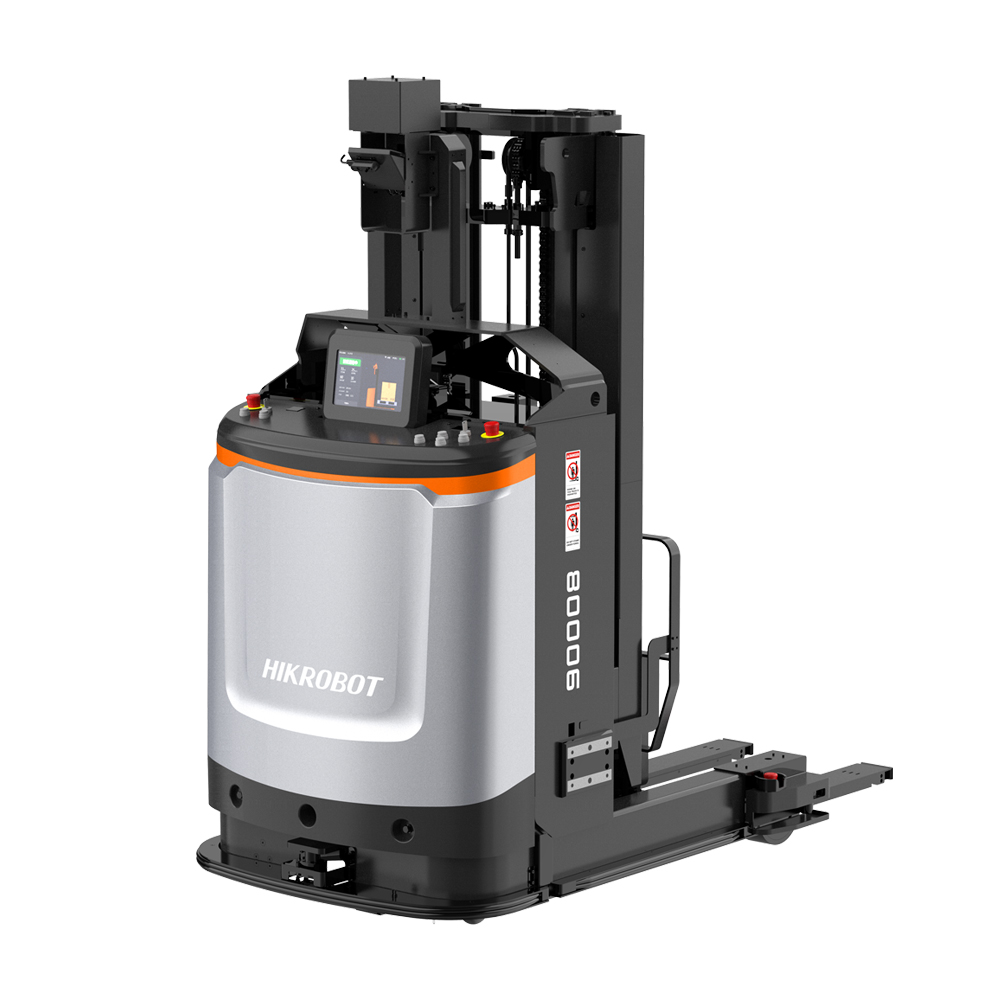
What Forklift Mobile Robots Actually Do on the Plant Floor
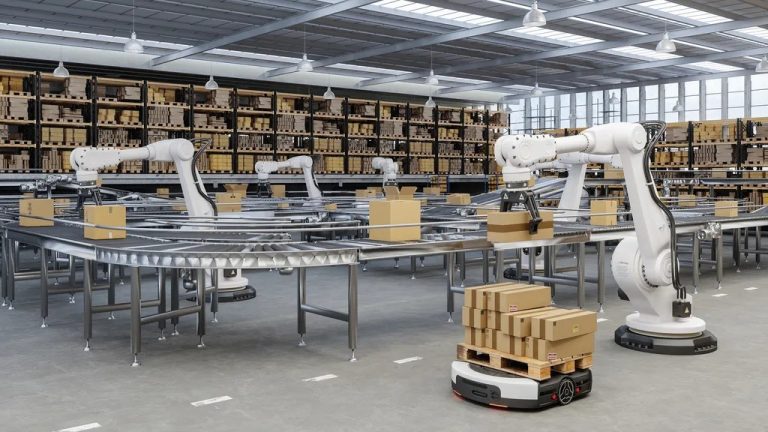
An FMR doesn’t just automate driving. It automates the entire responsibility of getting the right pallet to the right station at the right moment.
FMRs used in manufacturing typically perform:
Material feeding to assembly stations
They pull pallets of components or semi-finished goods from storage areas and deliver them directly to work cells, removing unpredictable wait times.
WIP (work-in-progress) transfers
Instead of drivers running loops between machining, testing, and assembly areas, FMRs transport WIP in a stable, continuous rhythm.
Finished goods movement
After packing or inspection, robots carry finished pallets to outbound buffer zones or automated warehouses.
Vertical pallet storage
With operating heights between 1.6 and 4 meters, they can store pallets in tall racks without the safety risks associated with high-bay manual forklifts.
Production line changeovers
When a line switches to a new model or batch, FMRs adapt quickly. No physical guidepath or floor reconstruction is needed. They simply update their routes through SLAM mapping.
This flexibility is one of the main reasons manufacturers are adopting them faster than expected.
Real Factory Scenarios Where FMRs Make an Immediate Difference
Let’s step into three common scenes inside manufacturing plants and see how FMRs change the game.
Scene A: Morning Material Feeding Rush
At 8:30 AM, several production lines begin their first cycle. Every line needs material almost at the same time. Forklift drivers try to juggle multiple calls, and eventually one cell ends up waiting.
FMRs approach this differently.
Jobs are queued automatically through the warehouse or production system. Robots dispatch themselves based on priority. Material arrives before the operator has to ask.
The day starts without the usual “firefighting.”
Scene B: High-frequency WIP Transfers
Machining, stamping, coating, assembling—production rarely follows a straight line. WIP moves constantly between departments.
When done manually, each transfer invites delay, misrouting, or inconsistent timing.
With FMRs:
- Routes stay consistent
- Travel time becomes predictable
- WIP flow matches cycle time
- There’s no “driver unavailable” moment
This stability feeds directly into higher production rhythm, especially in facilities with takt-time-driven processes.
Scene C: End-of-Shift Finished Goods Handling
Human drivers often speed up toward the end of a shift, trying to finish all pallet movements before leaving. This can bring safety risks and rushed work.
FMRs maintain the same steady pace throughout the shift.
They clear pallets to outbound buffers without stress, and operations feel less chaotic.
Why Manufacturers Prefer FMRs Over Traditional AGVs
Older AGV systems depend on fixed routes—magnetic strips, QR markers, reflective navigation. They work well in static environments, but modern factory layouts change frequently. New equipment gets installed, lines expand, or pathways shift.
FMRs rely on laser SLAM navigation, which provides:
- Precise positioning
- Dynamic obstacle avoidance
- Easy map updates
- Navigation that adapts to real factory movement patterns
There’s no ripping up floors. No re-laying tape. No “don’t touch this path” restrictions.
Factories finally get the flexibility they’ve always wanted.
Technical Advantages of FMRs That Matter in Manufacturing
The advantages listed in your uploaded PDF align directly with production pain points. Here are the ones that stand out most for factory leaders:
High load capacity (up to 1500 kg)
This fits pallets of raw materials, parts, molds, and semi-finished items commonly found in automotive, electronics, and metal processing lines.
Stable high-bay operations
FMRs support pallet storage at 1.6–4 meters without compromising safety—critical in plants with limited floor space.
Multi-vehicle coordination
Multiple FMRs can operate in the same plant with minimal interference, which is essential for multi-line, multi-shift environments.
Integrated with WMS / WCS / MES
This closes the loop between production planning and material execution—something manual workflows rarely achieve.
Improved safety through intelligent sensing
Laser-based obstacle detection and controlled driving speed help reduce forklift-related injuries, which remain a major pain point across many factories.
Consistent, repeatable workflow execution
Robots don’t skip steps. They don’t rush. They don’t take shortcuts. This consistency is gold for factories trying to improve takt time.
These technical strengths are not theory—they are the exact capabilities that manufacturers have been asking for over the past decade.
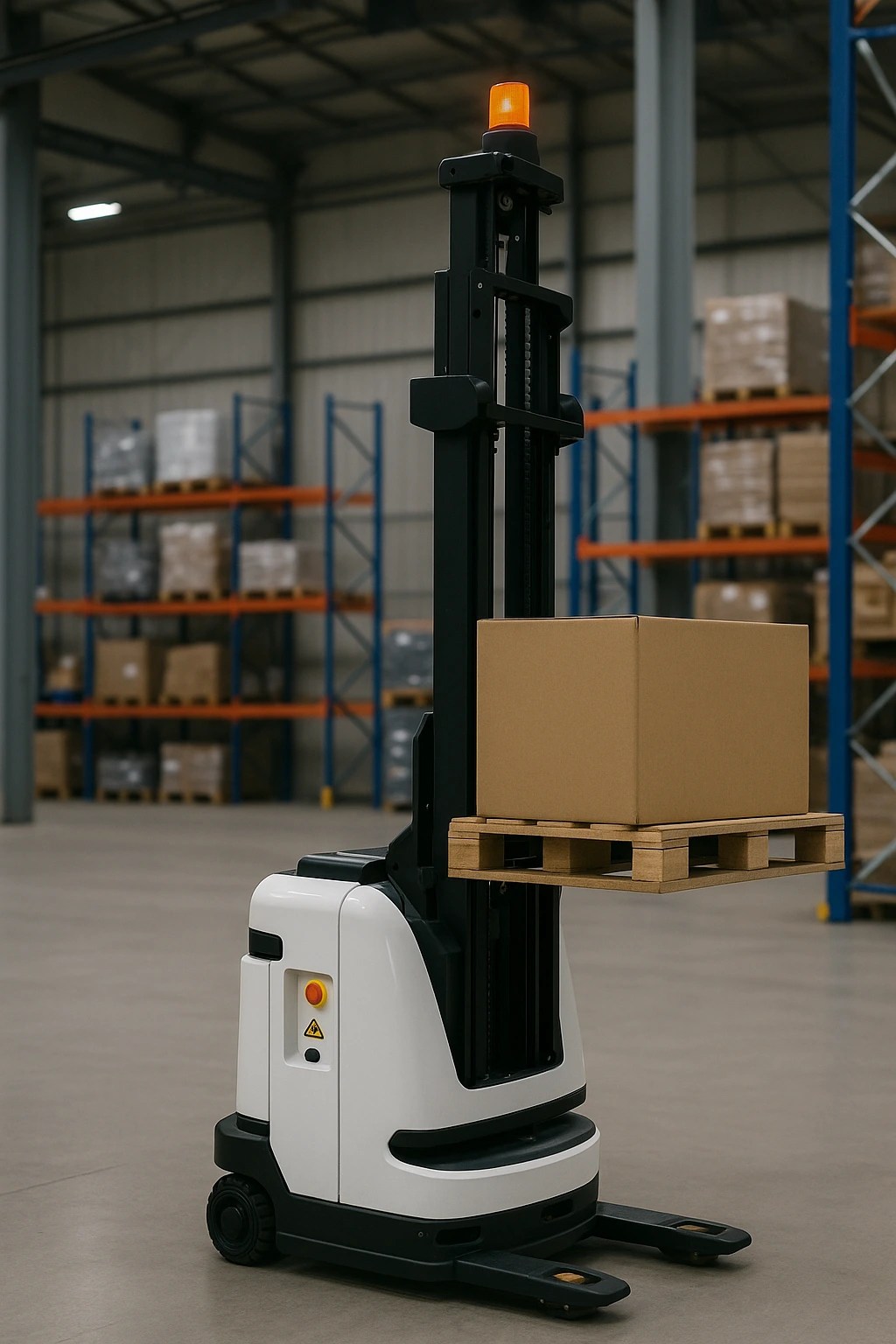
How FMRs Directly Boost Production Line Efficiency
Production line efficiency isn’t only about what happens at the line. It’s about how smoothly materials arrive, move, and leave.
Forklift mobile robots boost efficiency by:
Reducing idle time at workstations
When materials arrive exactly when needed, operators stay productive instead of waiting.
Maintaining WIP flow stability
Consistent pallet movement reduces bottlenecks and improves cycle time.
Removing manual variability
No delays due to shift changes, breaks, fatigue, or miscommunication.
Supporting 24/7 operations
Robots can cover night shifts without extra staffing.
Improving safety
Factories see fewer forklift incidents and near-misses, which reduces downtime and hidden costs.
Allowing layout flexibility
As production evolves, FMR routes update without major infrastructure changes.
For manufacturers juggling multiple product families and tight delivery schedules, this stability becomes a serious competitive advantage.
About Wesar Intelligence Co., Ltd.
威萨智能股份有限公司有限公司。 develops automation solutions designed for real industrial demands—not just ideal scenarios on paper. The engineering teams behind Wesar’s forklift mobile robots spend significant time inside customers’ factories, studying workflows, node timings, and real bottlenecks. That field-driven approach shows in the robots’ ability to navigate dynamic shop floors, pick and place pallets precisely, and work in coordination with other robots.
The company’s forklift mobile robots are built to support continuous production environments. Their design integrates SLAM navigation, stable lifting mechanisms, multi-robot scheduling, and smooth connectivity with WMS/WCS/MES systems. Rather than offering generic equipment, Wesar focuses on building systems that align tightly with each factory’s actual production rhythm and long-term automation roadmap.
结论
The move toward 叉车移动机器人 isn’t a trend—it’s a response to real production challenges. Manufacturers are discovering that improving production line efficiency isn’t only about upgrading machines on the line. It’s about improving how materials flow to and from those machines every minute of the day.
FMRs bring predictability to a part of operations that has historically been unpredictable. They deliver stable, repeatable, safe pallet movement, allowing production lines to run with fewer interruptions and higher confidence.
For factories pushing toward higher throughput, shorter delivery times, and smarter automation, forklift mobile robots are quickly becoming a foundational piece of the strategy.
常见问题
How do forklift mobile robots improve production line efficiency?
They keep materials flowing steadily to assembly or machining stations, reduce wait times, and maintain predictable WIP movement—key elements for efficient production.
Can forklift mobile robots handle different pallet types used in manufacturing?
Yes. FMRs typically support Euro, U.S., and custom pallet formats, with load capacities around 1500 kg, making them suitable for most industrial materials.
Are forklift mobile robots safe to use around workers and machinery?
They operate with controlled speeds and 360° obstacle detection. This reduces forklift-related risks and helps maintain safer production environments.
How do FMRs adapt when a factory layout changes?
Because they use SLAM navigation instead of fixed markers, FMRs update routes quickly when equipment moves or lines expand—no reconstruction required.
Are FMRs suitable for 24/7 production environments?
Absolutely. Robots can run across multiple shifts, support nighttime operations, and maintain a consistent workflow without adding staffing pressure.






 Chinese
  English
  Russian