
Most manufacturing inefficiencies don’t announce themselves. They show up as small delays that everyone learns to live with. A line pauses for a few minutes. Someone walks across the shop floor to ask where a pallet went. A forklift waits because the aisle is blocked again.
None of this looks serious on its own. But over time, it adds up.
In many factories, production equipment has improved faster than the systems that feed it. Machines are ready. People are ready. Materials are not. That gap is where intralogistics quietly becomes a limiting factor.
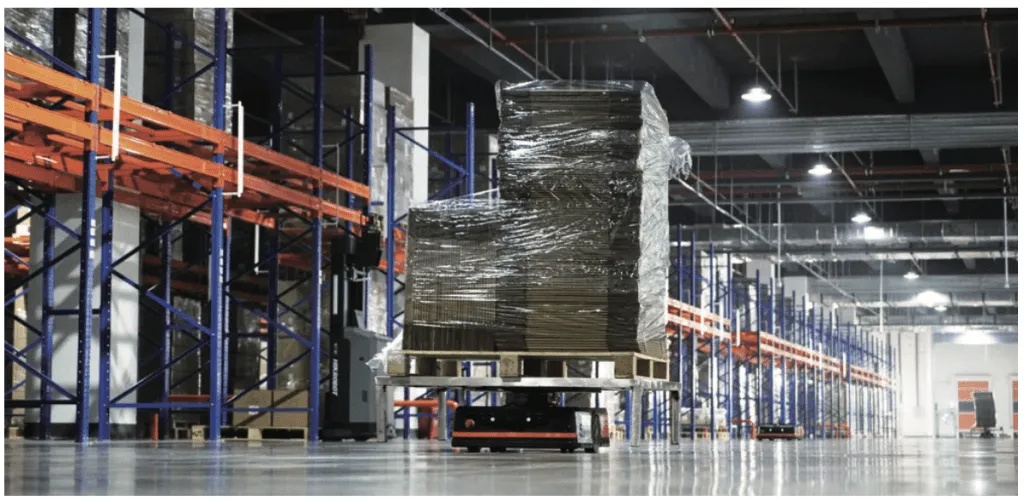
When Production Capacity Exists but Output Doesn’t
It’s common to hear managers say their lines are underutilized. Not because demand is low, but because flow is inconsistent.
Materials arrive late. Sometimes they arrive early and sit in the wrong place. Sometimes they exist in the system but can’t be located fast enough. These problems are rarely caused by a single mistake. They are structural.
As manufacturing shifts toward smaller batches and more frequent changeovers, manual coordination struggles to keep pace. What worked when products were stable starts to break when variability becomes the norm.
At that point, efficiency stops being a machine problem and becomes a logistics one.
Intralogistics Is No Longer “Support Work”
For a long time, internal logistics was treated as background activity. As long as materials moved eventually, the system was considered good enough.
That assumption is harder to defend now.
In high-mix environments, the timing of material movement matters as much as the movement itself. A delay of ten minutes at the wrong moment can disrupt an entire shift. Buffer stock helps, but only up to a point. After that, it creates its own problems.
Intelligent intralogistics changes the role of logistics from reactive to predictive. Instead of responding to shortages, the system works to prevent them.
AGVs Change Behavior Only When Treated as Part of a System
The Limits of Isolated Automation
AGVs are often introduced to replace manual transport. That’s a reasonable starting point, but it rarely delivers the full benefit.
When vehicles operate as isolated units, they inherit the same coordination problems as forklifts. Someone still decides what moves first. Someone still resolves conflicts. The difference is that now the system is automated but not necessarily smarter.
The real shift happens when AGVs operate under shared logic, responding to production signals rather than human dispatch.
Manufacturing Needs More Than One Type of Movement
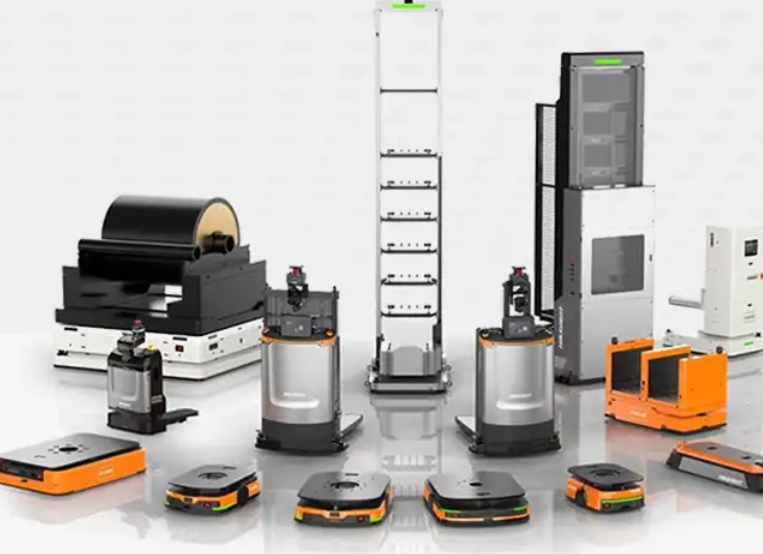
Factories move many kinds of materials. Small components. Large assemblies. Heavy loads. Fragile parts. No single vehicle type handles all of this well.
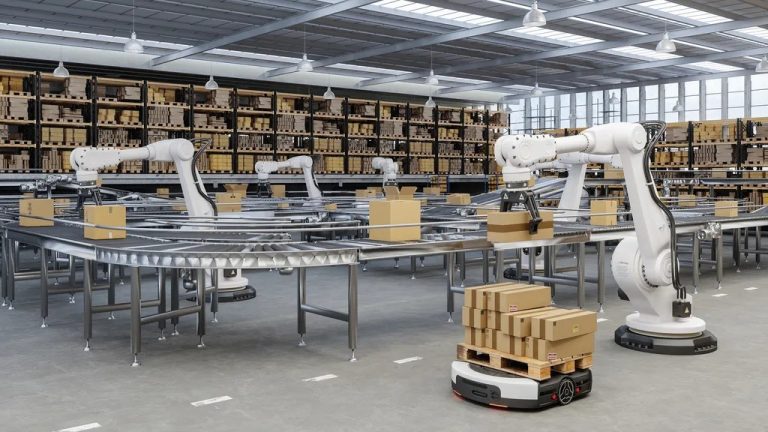
That’s why practical deployments rely on multiple robot forms working together. What matters is not uniform hardware, but unified control.
When routing, prioritization, and exception handling are centralized, the system adapts. Without that layer, complexity grows faster than capacity.
Smart Warehousing Only Works When It Talks to Production
Inventory Visibility Is Not the Same as Availability
Many warehouses are already “digital.” Inventory is tracked. Locations are known. Yet production still experiences shortages.
The reason is simple. Knowing where something is does not guarantee it will arrive when needed.
Smart warehousing becomes meaningful only when storage decisions are linked directly to manufacturing demand. Without that connection, optimization stays local and problems move downstream.
Closing the Gap Between Storage and Line-Side Use
When warehouse systems and mobile robots operate on shared priorities, material flow stabilizes. Requests are triggered automatically. Routes adjust as conditions change.
This reduces the need for urgent interventions, which are often the most disruptive. It also lowers reliance on informal knowledge that disappears when experienced staff are unavailable.
Where Intelligent Intralogistics Actually Pays Off
Not every factory sees the same results. The biggest improvements tend to appear where variability is already high.
High-mix production benefits from flexible routing. High-throughput lines benefit from predictable line-side delivery. Heavy or awkward materials benefit from consistent handling rather than ad hoc solutions.
In each case, the advantage comes from reducing uncertainty, not from moving faster.
Why Many Projects Underperform
Technology is rarely the main issue.
Some projects struggle because material flows were never clearly defined. Others automate unstable processes and lock in inefficiencies. In some cases, systems look impressive but fail to earn trust on the shop floor.
People find workarounds. Manual steps creep back in. Over time, the system becomes underused.
Successful deployments usually start with simpler questions. What actually needs to move? When does it need to arrive? What happens when something changes?
Designing for the Factory You’ll Have, Not the One You Have Now
Manufacturing layouts evolve. Products change. Volumes shift.
Systems designed for a single, perfect scenario don’t age well. Flexibility matters more than theoretical optimization.
Scalable intralogistics systems allow gradual expansion. Routes can change. Vehicles can be added. Logic can be adjusted without starting over.
That adaptability becomes valuable long after installation is complete.
A Practical Perspective on Wesar Intelligence Co., Ltd.
Wesar Intelligence Co., Ltd. approaches manufacturing automation from the standpoint that logistics and production cannot be separated. Its solutions focus on coordinated mobile robotics, system-level control, and integration with manufacturing operations.
Rather than treating robots as standalone assets, the emphasis is on how they function within broader workflows. This perspective aligns with manufacturers who value steady improvement over disruptive change.
The result is systems designed to operate reliably in real factories, not idealized ones.
Conclusion
Manufacturing efficiency rarely improves through dramatic changes. It improves through fewer interruptions, clearer signals, and systems that respond well when conditions shift.
Intelligent intralogistics addresses problems that machines alone cannot solve. By aligning material flow with production reality, it reduces friction that accumulates quietly over time.
AGVs and smart warehousing are tools. The real value comes from how they are used together.
FAQs
What makes intralogistics “intelligent” in manufacturing environments?
It’s the ability to coordinate material movement based on real-time production needs rather than fixed schedules or manual decisions.
Can AGV systems be added to existing factories without major disruption?
In many cases, yes. Gradual deployment allows processes to adapt while maintaining daily operations.
Why do some smart warehousing projects fail to improve production flow?
Because storage systems operate independently from production demand, creating visibility without responsiveness.
Which manufacturers benefit most from intelligent intralogistics?
Those dealing with frequent changes, tight takt times, or labor constraints typically see the strongest impact.
What should be clarified before investing in AGV-based systems?
Material flow logic matters more than vehicle specifications. Without that clarity, automation struggles to deliver value.






 English
  Russian
  Chinese