
Material handling teams in warehouses and factories have steadily shifted toward forklift automated guided vehicles—forklift AGVs—to take over routine pallet work. These autonomous forklift systems move loads independently, follow mapped routes, lift to required levels, and place pallets with consistent accuracy. Procurement discussions usually center on two distinct roles: flat pallet transport covering horizontal distances and high-level stacking focused on vertical rack access.
In horizontal scenarios, the emphasis stays on moving pallets efficiently across the same floor plane—supplying assembly stations, transferring between dock doors, or bridging to automated conveyors. Vertical applications concentrate on reaching multi-level racking, where precise placement at height enables higher storage density in selective, drive-in, or narrow-aisle setups.
Choosing between these configurations influences daily throughput rates, utilization of available cube space, ongoing labor exposure, and the timeline for capital recovery. With facility rents climbing and qualified operators remaining scarce, evaluation teams frequently revisit forklift AGV specifications to match real operational constraints. The sections below detail how each application performs, contrast the two approaches, and provide a structured method for narrowing options in present-day warehouse conditions.
What Is a Forklift AGV? Quick Overview
Forklift AGVs retain the essential elements of conventional counterbalanced or reach trucks—extendable forks, vertical masts, and stable chassis—while replacing the operator with onboard computing, sensors, and navigation logic. Guidance typically combines laser SLAM for dynamic mapping, visual feature recognition for landmark-based positioning, or hybrid methods that adjust to changing environments.
Chassis and mast designs vary according to primary duty. General-purpose counterbalanced frames manage standard lifting, whereas reach-style or straddle configurations target narrower aisles and greater elevation ranges. Integration with warehouse execution software assigns tasks, calculates collision-free paths, and synchronizes multiple vehicles during peak periods.
Most units accommodate standard pallet sizes with rated capacities from 1 to 3 tons. Lithium-based batteries commonly support extended runtimes, and multi-layer safety architecture—360-degree scanning, zone speed reduction, and redundant emergency stops—protects shared workspaces.
Flat Pallet Transport (Horizontal Handling) with Forklift AGV
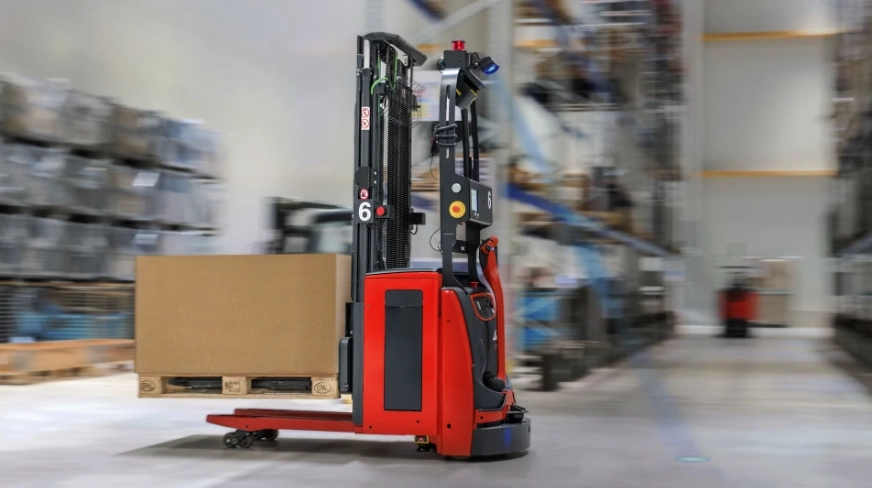
Long-distance horizontal pallet movement remains a dominant workflow in many facilities. Assembly plants route incoming materials from receiving to line-side buffers. Distribution operations shuttle completed orders from sortation zones to shipping docks. Forklift AGVs configured for flat pallet transport handle these repetitive transfers with dependable consistency.
Velocity during travel stands out as a decisive factor. Loaded units typically sustain 1.0 to 1.5 meters per second, while unloaded returns often exceed that rate. Uninterrupted operation across shifts eliminates downtime associated with breaks or driver changeovers, pushing higher pallet cycles in volume-sensitive environments.
Deployment complexity stays comparatively low. Flexible navigation adapts to existing floor layouts with limited need for fixed infrastructure such as magnetic tape or buried wires. Reduced site preparation shortens commissioning periods and accelerates the point at which savings begin to accrue.
Stability over distance holds up well, even across minor floor imperfections, because of low center-of-gravity construction and, in some models, active suspension elements. Real-time obstacle detection triggers deceleration or rerouting when personnel, carts, or other vehicles cross intended paths, sustaining safe performance without continuous monitoring.
Financial justification appears earlier in horizontal deployments. Steady elimination of shift labor, combined with fewer handling incidents and more predictable inventory placement, drives rapid payback. In facilities where high daily pallet counts occur primarily at ground level, full return on investment frequently falls between 18 and 30 months.
One mid-sized component manufacturer redirected cross-facility transport to autonomous units. Daily pallet throughput climbed over 40 percent while reportable incidents declined sharply. A contract logistics provider facing seasonal demand spikes maintained steady dock-to-storage movement without adding temporary staff, preserving margin during peak windows.
The principal constraint lies in vertical utilization. These systems optimize floor-level efficiency but leave overhead space largely untapped. Inventory growth within a fixed building envelope eventually requires denser configurations that horizontal-only units cannot support.
High-Level Stacking & Retrieval with Forklift AGV
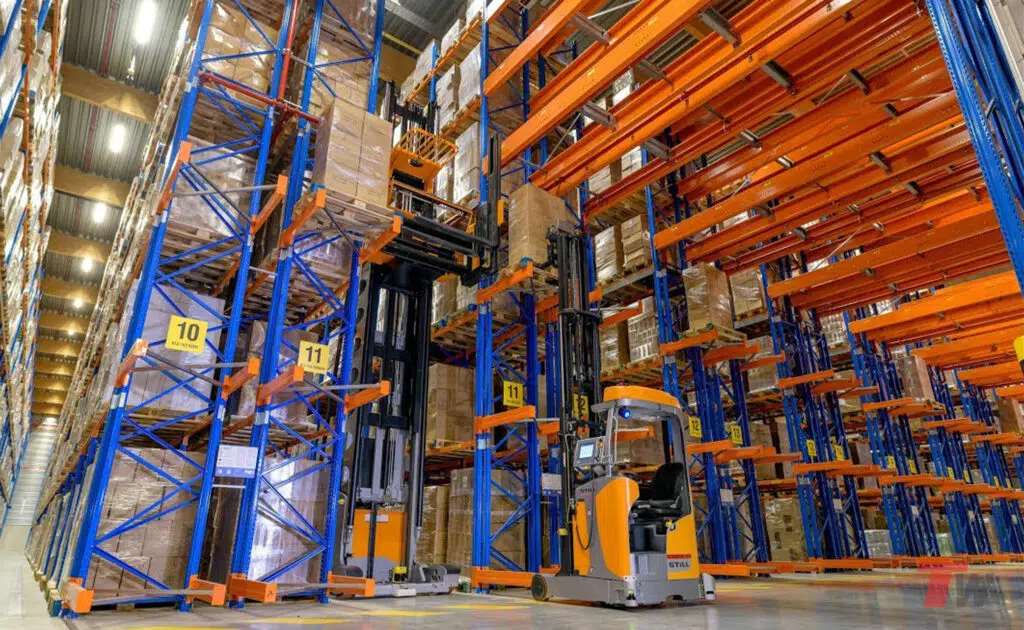
Multi-tier racking calls for vertical capability. Forklift AGVs engineered for high-level stacking elevate pallets to 3 meters and frequently beyond—reaching 5 meters or more in narrow-aisle variants—while depositing them squarely in designated rack locations.
Storage density improvement emerges as the overriding benefit. Vertical expansion typically increases pallet positions per square meter by 30 to 60 percent compared with conventional low-level layouts. In locations where footprint expansion carries prohibitive costs, the added capacity often offsets higher equipment pricing.
Positioning accuracy at elevation remains non-negotiable. Servo-controlled systems hold fork alignment within ±10 mm tolerances, even near maximum lift, reducing product damage and preventing rack structural stress. Guidance precision ensures pallets rest level and flush, minimizing future stability concerns.
Safety advantages grow pronounced in elevated work zones. Traditional manned reach trucks introduce fall exposure and operator fatigue that accumulate over long shifts. Autonomous execution removes those variables, providing uniform performance in confined aisles where manual maneuvering becomes impractical.
Unmanned capability aligns well with continuous-process environments. Refrigerated warehouses maintain throughput in sub-zero conditions where human productivity drops. Sensitive inventory categories—electronics components, pharmaceutical intermediates—benefit from reduced human contact and tighter process control.
Initial expenditures rise noticeably. Reinforced masts, heavier counterweights, additional sensors, and sometimes floor leveling add to the purchase price. Narrower operating aisles demand tighter tolerances, occasionally requiring preparatory modifications. Travel speeds decrease during lift and deposit phases to preserve load stability, lengthening cycle times compared with dedicated transport units.
Vertical deployments demonstrate strong economics when density drives value. Facilities that transitioned to high-level stacking report substantial increases in usable capacity, deferring or eliminating the need for satellite warehouses. One large-scale distributor achieved approximately 45 percent more pallet locations after adopting stacking-capable AGVs, with project payback occurring in less than four years.
Head-to-Head Comparison: Flat Transport vs High Stacking
Side-by-side evaluation clarifies where each configuration holds advantage.
Maximum lift height separates the categories decisively. Flat transport models concentrate on ground-level to low-elevation access—seldom exceeding 1.5 to 2 meters—while high-level stacking variants routinely achieve 3 to 5 meters, with specialized narrow-aisle designs extending further.
Average operational speed tilts toward horizontal movement. Sustained velocity over distance shortens task duration in flow-intensive applications. Stacking-focused units slow deliberately during vertical phases to guarantee control, accepting longer cycles for the sake of placement reliability.
Facility modification requirements diverge sharply. Horizontal integration proceeds with modest disruption. Vertical implementations often necessitate racking upgrades, surface corrections, and aisle width adjustments.
Acquisition cost follows the same pattern: transport-oriented models carry lower entry prices, stacking configurations command premiums due to structural and sensor complexity. Payback periods adjust accordingly—horizontal applications recover capital faster in high-movement, low-density settings, while vertical solutions generate larger absolute savings in footprint-constrained operations.
Application fit tracks these differences. Extended production lines and conveyor-linked zones align naturally with horizontal emphasis. High-density storage in e-commerce fulfillment, temperature-controlled logistics, and automotive tier-one supply favor stacking capability.
How to Choose: Decision Framework for Your Warehouse
Selection begins with an objective review of physical constraints and process demands.
Assess building clear height and racking arrangement first. Ceilings under 6 meters paired with wide aisles indicate horizontal transport priority. Taller structures already equipped with high-bay racking support investment in stacking configurations.
Map material flow patterns next. Document average travel distances, frequency of elevation, and peak hourly volumes. Predominantly long horizontal runs with occasional low lifts point toward transport models. Regular high-level retrieval and deposit justify vertical reach.
Reconcile budget with full lifecycle costs—purchase, deployment, software licensing, annual maintenance, and energy consumption. Balance those figures against anticipated reductions in labor hours, damage claims, and real estate requirements. Simulation models provided by suppliers help forecast realistic returns.
Account for future expansion and system interoperability. Multi-vehicle fleet management grows essential with scale. Native compatibility with current WMS, ERP, or MES platforms ensures uninterrupted task flow.
Hybrid deployments suit many mixed operations. Transport units manage long-distance legs while stacking models address vertical zones, with centralized software assigning vehicles based on task priority.
Wesar Intelligence Co., Ltd.: Provider of Forklift Mobile Robot Solutions
Wesar Intelligence Co., Ltd. develops integrated intelligent logistics and factory automation systems from its headquarters in Suzhou High-Tech District. The organization maintains a 5,000-square-meter production and development facility staffed by more than 100 engineers, technicians, and support personnel.
Core offerings include green intelligent logistics robots, warehouse management software, automated storage and retrieval equipment, conveyor lines, and bespoke material handling solutions. The forklift mobile robot family—designated FMR series—encompasses stacking configurations optimized for elevated operations and carrying/transport models tailored to horizontal pallet movement, both supported by reliable navigation and fleet-level coordination.
Nearly twenty years of project experience across electronics manufacturing, heavy machinery, automotive supply chains, and new energy sectors enable Wesar to deliver systems that improve inventory traceability, process repeatability, space efficiency, and cost discipline while minimizing operational variances.
Заключение
Horizontal pallet transport and high-level stacking represent the principal deployment patterns for forklift AGV technology. Flat movement delivers velocity, straightforward integration, and accelerated financial returns in facilities that emphasize throughput with limited structural alteration. Vertical stacking achieves superior density and elevated safety in operations constrained by available floor area.
Aligning the selected configuration with documented layout dimensions, observed material flows, capital thresholds, and projected growth delivers the strongest outcomes. Controlled site trials or detailed engineering assessments frequently resolve uncertainty prior to commitment.
Facilities that match forklift AGV characteristics to prevailing conditions secure sustained advances in operational throughput, personnel protection, and cost containment.
Часто задаваемые вопросы
What is the main difference between forklift AGV for flat pallet transport and high-level stacking?
Forklift AGVs intended for flat pallet transport concentrate on reliable horizontal transfer across production floors or warehouse zones with minimal elevation requirements. High-level stacking models incorporate extended vertical reach, allowing accurate deposit into multi-tier racks at heights measured in several meters while maintaining load control.
How high can a forklift AGV lift pallets in stacking applications?
Forklift AGVs configured for stacking generally achieve stable lift heights from 3 meters to 5 meters in standard configurations, with narrow-aisle variants capable of greater elevation. Rated capacity typically holds through the lower range before progressive derating at upper levels to preserve stability margins.
Which forklift AGV type offers faster ROI in a high-volume warehouse?
Flat pallet transport forklift AGVs ordinarily generate quicker capital recovery in high-throughput facilities dominated by extended horizontal distances. Consistent labor displacement and elevated cycle counts accumulate savings steadily, frequently within 18 to 30 months, especially where ground-level handling constitutes the bulk of activity.
When should a warehouse choose high-level stacking forklift AGV over flat transport models?
High-level stacking forklift AGVs warrant consideration when clear ceiling height surpasses 6 meters, racking infrastructure supports vertical density, and increasing storage positions per square meter provides greater value than incremental equipment cost. This configuration fits operations limited by footprint or managing elevated inventory value.
Can one forklift AGV handle both flat transport and high stacking tasks?
Versatile forklift AGV platforms can address mixed requirements, yet purpose-built designs deliver superior results. Transport-specialized units maximize efficiency over distance, whereas stacking-oriented configurations prioritize lift accuracy and height stability. Fleet management software coordinating specialized vehicles commonly provides the most practical solution for diverse workflows.





 Russian
  English
  Chinese